
2026 is already resetting the stakes.
Last year, more than 4,100 publicly disclosed data breaches were reported globally, nearly 11 a day, with the average cost reaching about $4.44 million.
That is not background noise. It is an early warning.
Every boardroom update, budget call, and security plan now converges under the same pressure. What actually shifts exposure, and what only feels reassuring because it has worked before.
This blog lays bare the top cybersecurity trends of 2026, the forces that determine who retains leverage, who carries the impact, and who learns too late that prior wins quietly narrowed their options.
1. CTEM Replaces Scanner-First Security Models
If vulnerability scanning is still the backbone of how you think about risk reduction in 2026, the issue is not tooling. The issue is the model.
Most large environments already generate continuous scan data across cloud, applications, and infrastructure. The constraint is no longer visibility. It is the inability to decide which issues matter and eliminate the exposure they create before the environment shifts again.
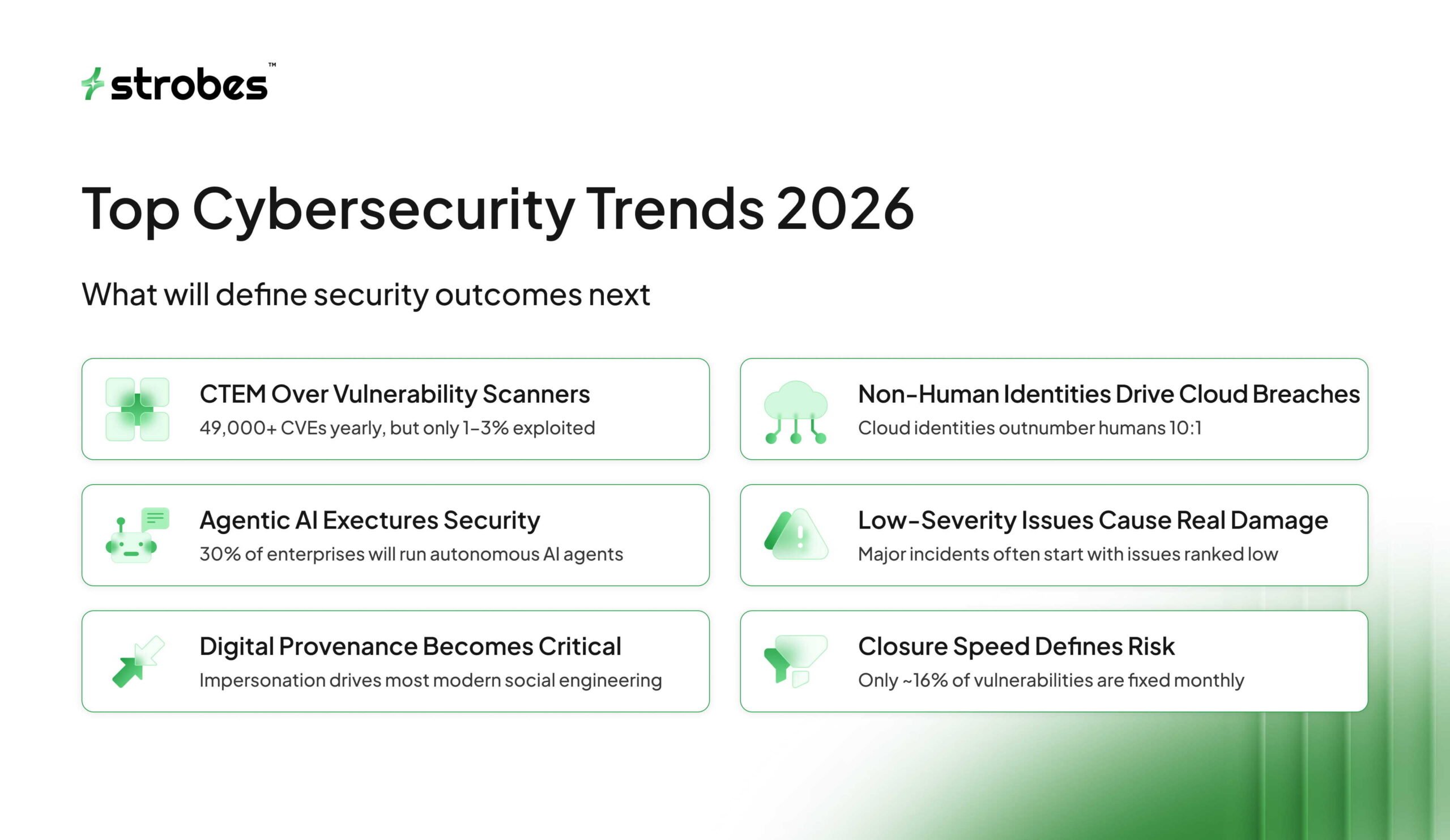
In 2025, a record 49,209 CVEs were published, a 43 percent increase over 2024, averaging roughly 135 new vulnerabilities every day. While nearly half were rated High or Critical, only about 1–3 percent were ever actually exploited in the wild.
That gap is not noise. It means your program is systematically prioritizing work attackers do not need to do. This mismatch sits at the center of several top cybersecurity trends of 2026, even when teams do not label it that way.
What Scanners Cannot Decide for You
Scanners report existence. They cannot determine the consequence.
A High score does not mean exploitable, and a Medium score does not mean safe. Yet backlogs are still prioritized as if severity equals risk, an assumption that is no longer defensible.
Cloud environments make this failure impossible to ignore. In 2025, misconfigurations accounted for roughly 23 percent of cloud security incidents, and 27 percent of organizations reported a cloud breach directly tied to misconfiguration.
A scanner can flag a vulnerable component, but it cannot tell you whether that component is exposed, reachable through a workload identity, or embedded in a revenue-critical path. Treating severity as a proxy for risk under these conditions is no longer a reasonable shortcut. It is a liability.
Why Scanner-First Programs Persist
Scanner-first programs persist because they make activity visible and defensible, even when outcomes are unclear.
They produce numbers, keep teams busy, and generate reports that suggest progress while real exposure remains unchanged. Coverage improves. Backlogs shrink. The most dangerous attack paths often remain untouched.
Validation is delayed to maintain throughput. Ownership fragments across teams. Context erodes between detection and remediation. Fix cycles stretch until the risk changes again.
Security activity increases. Risk does not decline.
How CTEM Changes the Decision Model
CTEM does not ask how many vulnerabilities you have. It asks which exposures allow an attacker to reach something that matters.
Scanner output becomes raw input, not a task list. Context is layered continuously, including reachability, identity, and permission paths, asset importance, and exploitable sequences. The result is a live exposure view that mirrors how attacks actually unfold.
Attackers do not work through severity lists. They follow paths of least resistance. CTEM models those paths continuously, while point-in-time assessments decay almost immediately.
The Moment Scanner-First Thinking Fails
Counting vulnerabilities closed measures effort, not safety. The only signal that reflects real risk reduction is time to verified exposure closure, yet most teams cannot measure it, and many dashboards actively obscure the gap by rewarding scan volume and closure counts. As a result, scanner-centric programs keep fixing large numbers of issues while attackers reuse the same small set of reachable paths. Confidence in security reporting erodes not because teams are ineffective, but because the model no longer matches reality.
If scanning is still your primary signal, you are optimizing effort while attackers optimize opportunity. That reality underpins multiple top cybersecurity trends of 2026, even when organizations resist naming it.
2. Non-Human Identities Become the Primary Cloud Breach Vector
Your cloud runs on credentials that almost no one owns and even fewer people review.
Service accounts, workload identities, API tokens, CI/CD credentials, and SaaS integrations now power production systems at scale. They outnumber humans, bypass human-centric controls, and quietly hold the authority to deploy infrastructure, access data, and invoke internal services.
Google Cloud reported that service accounts outnumber human identities by at least 10 to 1 in most enterprise environments, and that these identities frequently carry broad, long-lived permissions because rotating or auditing them risks breaking production. This is not a misconfiguration. It reflects how your program routinely trades control for operational convenience.
Why These Identities Are So Dangerous
Non-human identities do not behave like users, which is exactly why they slip through controls.
- They do not log in interactively.
- They do not trigger MFA.
- They do not look suspicious when they access systems at scale.
Most importantly, they are rarely reviewed.
Over 40 percent of cloud environments contain service accounts or workload identities with unused but highly privileged permissions. That means some of the most powerful credentials in your environment are trusted by default and questioned by nobody.
Once compromised, a non-human identity grants automation-level trust. At that point, lateral movement and persistence look indistinguishable from normal system behavior.
Where the Model Breaks
Identity risk is still treated as a user problem, even though non-human identities now hold broad, largely unreviewed control over cloud infrastructure.
Non-human identities:
- Do not expire when employees leave
- Rarely have a single accountable owner
- Accumulate permissions silently over time
- Sit outside regular access review cycles
Yet they can deploy infrastructure, access sensitive data, and invoke internal services without friction. When identity reviews stop at users, the most dangerous access paths remain unmanaged.
Why This Becomes a Breaking Point in 2026
The fastest way to expose this risk is not another inventory. It is one question:
What percentage of non-human identities have a clear owner, a defined purpose, and a reviewed permission boundary?
Most organizations cannot answer it.
Automation is accelerating. CI/CD pipelines are expanding. Agent-driven systems are being granted tool access. Every one of these shifts increases reliance on identities that blend into normal automation traffic and persist long after compromise. Attackers already understand this and target it deliberately.
When identity risk is still treated as a human problem, attackers are already operating in the part of your cloud you are not watching.
3. Agentic AI Becomes a New Execution Layer in Security
Security actions are now happening faster than most teams can confidently explain after the fact.
Agentic AI is moving beyond recommendations into execution. Creating tickets, orchestrating workflows, correlating signals across tools, triggering scans, and coordinating response steps automatically. This shift is not about replacing people. It is about removing friction from work that does not scale manually.
Gartner projected that by 2026, more than 30 percent of enterprise AI deployments would involve autonomous or semi-autonomous agents with direct access to operational systems, reflecting growing confidence in agent-driven execution across IT and security.
This marks a structural shift. Execution is no longer a human bottleneck.
Why This Is a Real Advantage
Agentic systems solve problems security teams have lived with for years.
- They reduce manual triage.
- They keep remediation moving when teams are overloaded.
- They connect signals across fragmented tools.
- They bring consistency to workflows that humans cannot sustain at scale.
Used well, agentic AI improves speed, follow-through, and operational clarity. That value is real, which is why adoption is accelerating.
Speed, however, always relocates responsibility.
Where Accountability Quietly Shifts
The challenge is not that agents act. The challenge is who owns what they execute.
Agentic systems collapse the distance between decision and action by design. An agent can interpret input, decide what to do, and execute across multiple systems in a single flow. When something goes wrong, that chain is difficult to unwind.
Research in 2025 revealed that LLM-powered agents can be influenced through indirect inputs or tool misuse to perform unintended actions, even when guardrails are in place.
This is not an AI failure. It is what happens when execution authority expands faster than ownership models.
The Responsibility Most Teams Haven’t Claimed
As agents gain access to tools and workflows, the core issue shifts from capability to responsibility.
In many environments today:
- Agents inherit permissions from service accounts
- Action-level approvals are implicit
- Logging captures outcomes, not intent
- Pause and rollback paths are unclear
When an agent takes an action, it is often unclear who approved it, who owns it, or who is accountable for reversing it. That ambiguity is the real risk surface.
Why This Matters More in 2026
Agentic AI will spread because it works. That inevitability makes execution boundaries, validation, and ownership non-negotiable. This tension between speed and accountability is one of the defining top cybersecurity trends of 2026, even beyond AI itself. Agentic AI multiplies security effectiveness, but any execution authority you do not design deliberately will be inherited by default, and eventually abused.
4. Low-Severity Issues Create the Highest Business Impact
The fastest path to real damage usually starts at the bottom of your vulnerability backlog.
Most serious incidents do not begin with something labeled Critical. They begin with issues dismissed because they did not look urgent enough to disrupt plans. A low-severity misconfiguration. A minor access control gap. A logic flaw in a workflow is assumed to be safe. On their own, these issues look harmless. In context, they become the entry point.
Why Severity Is a Poor Proxy for Risk
Severity scoring measures technical impact in isolation. It was never designed to reflect business exposure.
A low-severity issue can sit directly on a production workflow, be reachable without authentication, enable lateral movement, or expose sensitive data without resistance. None of that is captured by a severity score.
As a result, teams close what looks dangerous on paper while leaving behind issues that sit closer to revenue, customer data, or operational control. This pattern repeats across incident reviews and explains why prioritization failure shows up so consistently in the top cybersecurity trends of 2026.
How Real Incidents Actually Happen
High-impact incidents are rarely driven by a single catastrophic flaw.
They unfold through chains of small failures. A low-severity exposure enables initial access. A permissive workflow allows expansion. A trusted system is abused in a way it was never designed to resist. Each step looks tolerable in isolation. Together, they lead to material impact.
For example, researchers uncovered a publicly accessible Amazon S3 bucket exposing highly sensitive personal and operational data at scale. There was no critical vulnerability and no sophisticated exploit chain. The exposure started with a basic access control mistake, the kind that usually ranks low, gets deferred, and never makes it to the top of a backlog. Once reachable, that “minor” issue turned into an immediate, large-scale impact.
This is why post-incident reviews often conclude that nothing “critical” was missed, even when the outcome is severe. The failure was not detection; it was prioritization.
Where Programs Go Wrong
Most remediation workflows still ask the wrong question first. They ask how bad a vulnerability looks instead of where it sits, what it can touch, and what happens if it is abused.
Low-severity issues are routinely pushed aside because they do not threaten availability directly, lack a known exploit, or get buried under louder findings. That logic optimizes for technical cleanliness, not business resilience.
The Question That Exposes the Risk
Stop asking how many low-severity issues are open and ask a more uncomfortable question instead: which low-severity findings sit directly on workflows that matter? Most organizations cannot answer this quickly, and that blind spot is where risk quietly concentrates.
As environments change faster, the distance between a “minor” issue and a material outcome keeps shrinking. Applications evolve weekly, permissions drift continuously, and external exposure expands without deliberate review. Attackers are not searching for the loudest flaw. They are looking for the quiet issue that leads somewhere valuable.
When low-severity issues are dismissed by default, high-impact outcomes are being invited by design.
5. Digital Provenance Becomes a Big Deal
By 2026, the biggest security question inside enterprises is no longer “Who accessed this?” but “How do we know this was legitimate in the first place?”
That shift matters because most security controls were built to answer the first question. Very few can answer the second with confidence.
Enterprises are discovering that identity, access logs, and audit trails are no longer sufficient when content, requests, and approvals themselves can be convincingly fabricated. The risk is no longer unauthorized access. It is unverifiable legitimacy.
Trust Is Breaking at the Workflow Level
Digital trust used to be implicit. An email from finance was trusted because it came from the finance domain. A document was trusted because it lived in the right system. An approval was trusted because it was logged.
That logic collapses in an environment where messages, documents, and even voices can be generated with realistic context at scale.
In 2025, impersonation-based attacks accounted for more than 60 percent of reported social engineering incidents, driven by increasingly convincing synthetic content and contextual targeting.
At the same time, business email compromise alone led to more than $2.9 billion in reported losses, despite widespread deployment of email security and identity controls.
The failure is not a lack of visibility. It is a lack of proof.
What Existing Controls Can No Longer Defend
Identity systems, logs, and audit trails record activity. They do not establish legitimacy.
They can show who authenticated, what system was touched, and when an action occurred. They cannot prove whether a request was genuine, whether the content was altered, or whether an approval was earned rather than induced. Continuing to rely on these controls as proof of trust is no longer a design limitation. It is an indefensible assumption.
When incidents occur, teams can reconstruct timelines but cannot prove whether a request, document, or decision was real.
Where Trust Quietly Collapses
Provenance failures stay hidden until something goes wrong. Before an incident, approvals look valid, requests appear routine, and actions follow the process. After an incident, no one can prove which instruction was legitimate. Logs show activity, not authenticity, and investigations turn into arguments instead of conclusions. At that point, the issue is no longer technical. It is credibility.
Many teams still operate on a faulty assumption that identity plus logging equals trust. Identity only tells you who acted. Provenance tells you whether what they acted on was real. Treating these as interchangeable creates blind spots that surface only during fraud, disputes, or audits, when proof is demanded, and confidence is no longer enough.
Where This Becomes Non-Negotiable
The real test is whether you can prove the origin and integrity of a critical decision after the fact.
If you cannot:
- Demonstrate where the content originated
- Show how it changed across systems
- Explain why it was trusted at the moment of action
Then you do not have provenance. You have confidence without proof.
As impersonation, synthetic content, and workflow manipulation scale, trust shifts from assumption to evidence. Teams that cannot establish provenance will struggle to:
- Defend decisions internally
- Satisfy auditors and regulators
- Close incidents cleanly
In 2026, trust without provenance is belief without evidence.
6. Validation and Closure Speed Become the Real Bottleneck
Security teams are not failing to find issues. They are failing to confirm which ones matter and close them before attackers move.
Most environments generate findings continuously, but the path from detection to verified closure is slow, fragmented, and poorly owned. That delay, not lack of visibility, is where exposure now lives.
Industry data shows organizations remediate only about 16 percent of vulnerabilities per month on average, which means unresolved exposure accumulates faster than it is removed.
Why Validation and Closure Collapse at Scale
Closing real exposure is not a single action. It is a chain of decisions that breaks under load.
To eliminate risk, teams must confirm reachability, understand exploit paths, assign ownership across security and engineering, deliver a fix safely, and verify that the exposure is actually gone. Each handoff adds delay. Each delay extends the attack window.
Remediation studies show that around 40 percent of teams are blocked by non-actionable findings, and nearly the same number are slowed by poor cross-team collaboration.
Without context and ownership, validation stalls and closure drifts.
Where Most Security Programs Actually Fail
Detection creates volume. Validation creates a signal. Closure creates safety. Most programs are strong at detection and structurally weak at validation and closure because urgency disappears without context, ownership fragments, and fix verification becomes optional. You can detect endlessly and still remain exposed.
The only metric that exposes this failure is time from validated exposure to verified closure. If you cannot measure how fast confirmed risk is eliminated, you are not managing exposure. You are managing tickets.
Finding issues is routine. Confirming they matter is hard. Closing them fast enough is what separates control from exposure. If validation and closure move more slowly than attackers, visibility does not protect you.
Takeaway
If there is one takeaway from the top cybersecurity trends of 2026, it is this. The problem is no longer the sophistication of attacks. It is tolerance for broken operating models. Programs built around detection, periodic assessment, and severity rankings are being outpaced by attackers who move faster and chain weaknesses more efficiently.
The winners are not the teams with the most tools or alerts. They are the teams that collapse decision cycles, validate exposure continuously, and close risk before it compounds. Everything else is noise.
2026 will not punish teams for missing threats. It will punish teams that saw the risk and still could not move.