

Bug Bounty vs. Pentesting vs. AI Pentesting: Which Model Fits Your AppSec Program?
- ✓Bug bounty programs (HackerOne, Bugcrowd) give you crowd-sourced creativity on a pay-per-result basis, but coverage is unpredictable, triage overhead is high, and critical findings can cost $5K–$50K+ each.
- ✓SPA-specific vulnerabilities include Traditional penetration testing delivers structured methodology and compliance-ready reports (SOC 2, ISO 27001, PCI DSS), but it’s point-in-time, expensive ($5K–$50K+ per engagement), and hard to run more than once or twice a year.
- ✓AI pentesting combines the structure of traditional pentests with the speed of automated scanning, runs continuously on a schedule, and produces compliance-mapped reports at a fraction of manual testing costs.
- ✓Most mature AppSec programs will use all three models for different purposes: AI pentesting for continuous breadth, traditional pentests for deep-target assessments, and bug bounties for edge-case creativity.
- ✓Disclosure: Strobes offers AI-driven pentesting and exposure management. We’ve noted where our platform applies and where other approaches are the better fit.
What Are the Three Models, and Why Does the Choice Matter?
Three distinct testing models dominate AppSec today: bug bounty programs, traditional penetration testing, and AI-driven pentesting. Each one answers a different question about your security posture, and picking the wrong model (or relying on just one) leaves blind spots.
Bug bounties crowdsource testing to independent researchers who get paid per valid finding. Traditional pentesting hires a firm or consultant to run a structured, time-boxed assessment against a defined scope. AI pentesting uses autonomous agents to execute pentest methodology (recon, exploitation, reporting) continuously, without waiting for a human tester’s calendar to open up.
The choice matters because your attack surface doesn’t wait for your next quarterly pentest. Code ships daily. Infrastructure changes weekly. A testing strategy that made sense in 2020, when annual pentests were the norm, doesn’t hold up when your CI/CD pipeline pushes 50 deploys a week.
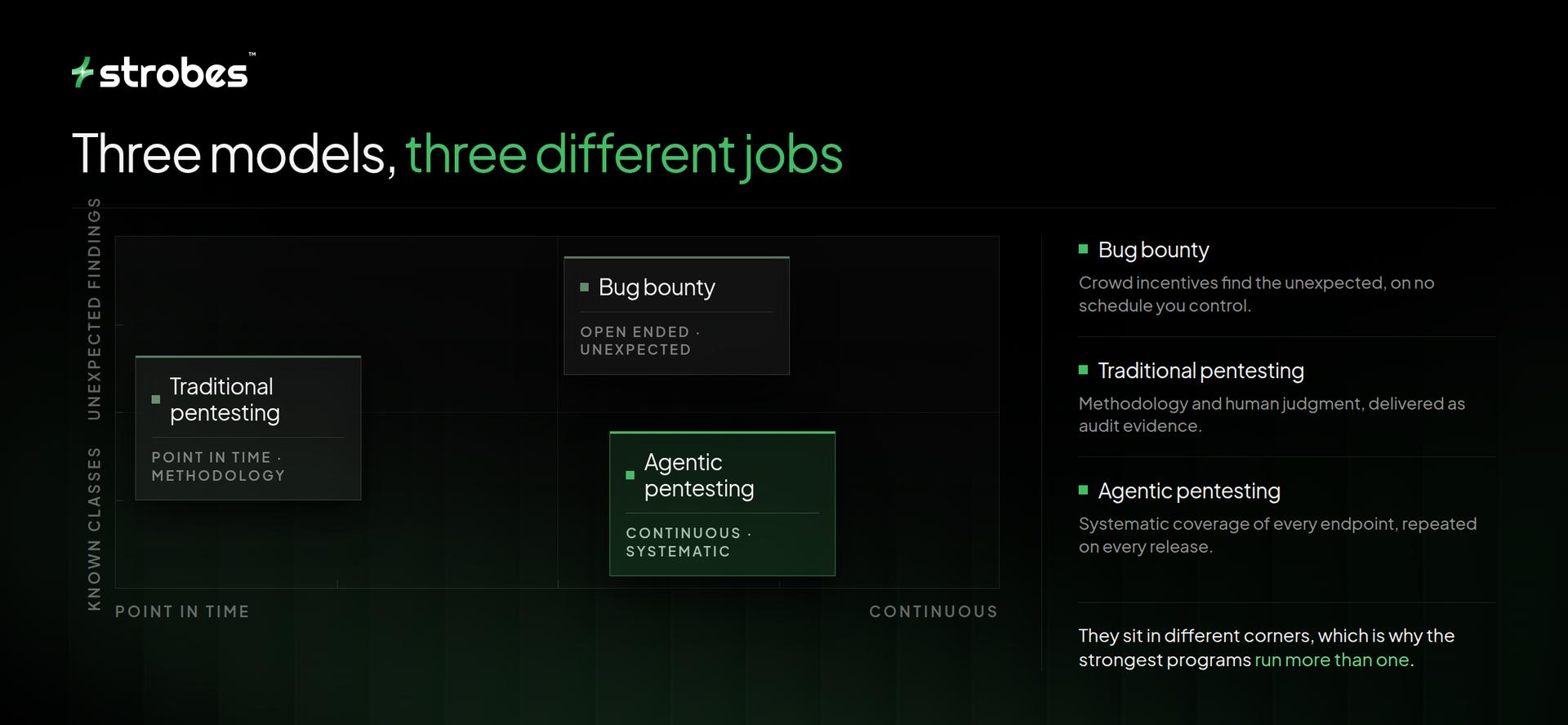
Let’s break down each model honestly, then figure out where each one belongs in your program.
How Do Bug Bounty Programs Actually Work?
Bug bounty programs pay independent security researchers to find and report vulnerabilities in your applications, APIs, or infrastructure. Platforms like HackerOne and Bugcrowd act as intermediaries, managing researcher onboarding, report triage, and payouts.
The model is simple: you define a scope, set reward tiers by severity, and invite (or publicly open) testing from the crowd. Researchers hunt for bugs on their own time, and you only pay when they submit a valid, unique finding.
HackerOne’s programs collectively paid out $81 million in bounties between mid-2024 and mid-2025, a 13% year-over-year increase. Bugcrowd reports average accepted-report payouts between $300 and $3,000, with top payouts exceeding $50,000 for critical findings.
The real strengths
Bug bounties shine where creativity matters. A crowd of researchers brings diverse skill sets, tooling, and perspectives that no single team can match. Some researchers specialize in OAuth misconfigurations. Others focus on API business logic flaws. A few are exceptionally good at chaining low-severity issues into critical exploits. You’re buying that diversity.
The pay-per-result model also means you’re not paying for hours spent finding nothing. If researchers don’t find bugs, you don’t pay. That feels efficient on paper.
And bounties run continuously. Your program doesn’t have a start date and end date the way a pentest engagement does.
The real weaknesses
Coverage is the biggest problem. Researchers are rational actors who optimize for payout per hour. That means they gravitate toward low-hanging fruit: known vulnerability patterns, common misconfigurations, and easy-to-test endpoints. The obscure admin panel behind two layers of authentication? Nobody’s testing that when there’s easier money on another program.
Triage burden is real. Bugcrowd reported that AI-generated submissions more than quadrupled during a three-week period in early 2026, with most turning out to be false positives or low-quality reports. Even without the AI noise, you’ll spend significant engineering time reviewing duplicates, out-of-scope reports, and findings you’ve already accepted from another researcher.
There’s no guaranteed testing schedule. You can’t tell your auditor “we tested the payment flow on March 15th” because you don’t control when or whether researchers test specific components.
Cost is unpredictable too. A single critical RCE finding might cost you $10,000–$50,000+. If a researcher finds five of them in a quarter, your security budget takes a hit you didn’t plan for. Organizations running programs on Bugcrowd commonly allocate $150,000 to $500,000+ annually for payouts alone, before platform fees.
Bug bounties also don’t produce the structured evidence that compliance auditors expect. You get individual finding reports, not a methodology-based assessment document.
What Makes Traditional Pentesting Still Relevant?
Traditional pentesting is a time-boxed, scope-defined engagement where professional testers follow a recognized methodology (PTES, OWASP Testing Guide, NIST SP 800-115) to systematically assess your applications or infrastructure. It’s the model auditors know, procurement teams understand, and compliance frameworks explicitly reference.
The output is a report that maps findings to a structured methodology, includes evidence of what was tested (not just what was found), and satisfies the documentation requirements of SOC 2 Type II, ISO 27001 Annex A, PCI DSS Requirement 11.3, and HIPAA security assessments. For a SOC 2 Type II audit covering a 12-month period, auditors expect to see at least one penetration test within that window.
The real strengths
Structure is the core advantage. A good pentest firm doesn’t just check for OWASP Top 10 issues. They test business logic flaws, authorization boundaries, session management edge cases, and chained attack paths that require human reasoning. They follow PTES or OSSTMM end to end, which means every component in scope gets tested, not just the ones that are easy or profitable.
You get guaranteed scope coverage. The statement of work specifies exactly what gets tested, and the report documents both findings and areas tested with no issues found. That “tested clean” evidence matters for compliance.
Human testers also catch things that automated tools miss entirely: race conditions in payment flows, privilege escalation through multi-step business processes, and social engineering vectors that require understanding how the application is actually used.
The real weaknesses
Frequency is the killer. Traditional pentests cost $5,000–$50,000+ per engagement depending on scope and complexity. Web application tests typically run $5,000–$30,000, network tests $7,000–$35,000, and complex red team exercises can exceed $100,000. At those prices, most organizations test once or twice a year.
That means you’re getting a snapshot. Your pentest report from January doesn’t reflect the 200 code changes you shipped in February. By the time you get the report (typically 2–4 weeks after testing ends), the application has already changed.
Scheduling is slow. Booking a reputable pentest firm often requires 4–8 weeks of lead time. If you need a test before a product launch next month, you might be out of luck.
And human testers don’t scale linearly. Testing 5 web applications costs roughly 5x what testing one costs. For organizations with 50+ applications, annual pentesting of every app is financially impractical, which means you’re choosing which apps get tested and which ones don’t.
What Is AI Pentesting, and How Is It Different from a Vulnerability Scanner?
AI pentesting uses autonomous agents that execute actual penetration testing methodology, not just signature-based scanning. The agent performs recon, identifies attack surfaces, selects appropriate tools (Nuclei, sqlmap, Burp-style crawling, custom scripts), attempts exploitation, chains findings, and produces a structured report. It’s the difference between checking a list of known CVEs and actively trying to break into your application.
This distinction matters. Vulnerability scanners (Nessus, Qualys, OpenVAS) check for known vulnerabilities using signature databases. They’re fast and useful, but they don’t test business logic, attempt exploitation, or chain findings together. A scanner tells you “this server runs Apache 2.4.49.” An AI pentester tells you “this server runs Apache 2.4.49, path traversal via CVE-2021-41773 is exploitable, and I confirmed read access to /etc/passwd.”
The real strengths
Speed and frequency change the math entirely. An AI pentest that takes 4 hours instead of 4 days means you can test after every sprint, not once a year. You go from point-in-time snapshots to continuous assurance.
The methodology is structured, just like a traditional pentest. AI agents follow OWASP Testing Guide and PTES phases: reconnaissance, enumeration, vulnerability analysis, exploitation, and reporting. The output maps to compliance frameworks the same way a manual pentest report does.
Cost at scale is where AI pentesting pulls ahead. Testing one application might cost a similar amount to a basic manual test. Testing 50 applications costs a fraction of 50 manual tests. The per-test economics improve dramatically as your application portfolio grows.
Reports are compliance-ready from the start. You don’t wait 2–4 weeks for a consultant to write up findings. The report generates automatically, mapped to the controls your auditor cares about (SOC 2, ISO 27001, PCI DSS 11.3).
And scheduling is trivial. Set up a weekly or monthly schedule, and testing happens automatically. No procurement cycle, no waiting for a firm’s availability.
The real weaknesses
AI agents are still maturing on novel attack chains. A human tester who spots an unusual authentication flow can reason about it creatively, try unexpected inputs, and chain subtle logic flaws together in ways that current AI agents don’t match consistently. Complex business logic testing (multi-step workflows, payment fraud scenarios, role-based access control edge cases) still benefits from a human tester’s intuition.
AI pentesting also can’t do physical security assessments, social engineering, or vishing campaigns. If your threat model includes a researcher walking into your office with a USB drop, that’s a human engagement.
The technology is moving fast. The gap between what AI agents find and what human testers find shrinks every quarter, but it’s not zero today. Being honest about this is what separates a credible recommendation from a sales pitch.
See How an AI Agent Runs a Full Pentest — Not Just a Scan
You just learned how AI pentesting reasons about applications, chains findings, and produces compliance-ready reports. Watch it happen live: recon, tool selection, exploitation, and structured reporting against a real target.
Watch the full walkthrough — no signup required.
How Do the Three Models Compare Side by Side?
Here’s the comparison across the dimensions that actually matter when you’re building an AppSec program:
| Dimension | Bug Bounty | Traditional Pentest | AI Pentesting |
|---|---|---|---|
| Testing approach | Crowd-sourced, researcher-driven | Structured methodology (PTES, OWASP) | Autonomous agent following pentest methodology |
| Coverage model | Researcher’s choice (cherry-picked) | Guaranteed scope coverage | Guaranteed scope coverage |
| Frequency | Continuous (but unpredictable) | Point-in-time (1–2x/year typical) | Continuous (scheduled daily/weekly/monthly) |
| Time to results | Hours to months (researcher-dependent) | 2–6 weeks (test + report) | Hours (automated end-to-end) |
| Cost model | Pay-per-finding ($300–$50K+ per bug) | Fixed fee per engagement ($5K–$50K+) | Credits-based or subscription (predictable) |
| Annual cost at scale (10+ apps) | $150K–$500K+ in payouts + platform fees | $50K–$300K+ for full coverage | Significantly lower per-app cost |
| Compliance evidence | Weak (no methodology documentation) | Strong (PTES/OWASP mapped reports) | Strong (methodology-mapped, auto-generated) |
| Business logic testing | Strong (human creativity) | Strongest (dedicated expert testers) | Improving, but weaker on novel chains |
| Scalability | Scales with researcher interest | Scales linearly with cost and calendar | Scales with compute, not headcount |
| Triage burden | High (duplicates, noise, AI-slop) | Low (single firm, single report) | Low (structured, deduplicated output) |
| Scheduling control | None (researchers test when they want) | Full (but requires lead time) | Full (set it and forget it) |
| Best for | Edge-case creativity, ongoing vigilance | Deep assessments, compliance, complex targets | Continuous breadth, large portfolios, fast cycles |
Which Model Satisfies Compliance Requirements?
For SOC 2 Type II, ISO 27001, and PCI DSS 11.3, you need documented evidence that penetration testing was performed using a recognized methodology, with findings tracked to remediation. Both traditional pentesting and AI pentesting satisfy this requirement. Bug bounties, on their own, typically don’t.
Here’s why. Compliance auditors look for three things in a pentest:
- Methodology documentation. The report must reference PTES, OWASP Testing Guide, NIST SP 800-115, or an equivalent standard. Traditional pentests and AI pentests produce this. Bug bounty reports don’t; they document individual findings without a testing methodology framework.
- Scope coverage evidence. Auditors want to know what was tested, not just what was found. A pentest report that says “we tested all OWASP Top 10 categories against the target application and found no issues in categories X, Y, Z” provides negative assurance. Bug bounty reports only document what researchers chose to look at.
- Timeliness. SOC 2 Type II covering a 12-month period expects at least one pentest during that window. PCI DSS requires testing annually and after significant changes. AI pentesting’s scheduled cadence (weekly, monthly) naturally satisfies these windows. Traditional pentests require you to plan ahead. Bug bounties don’t provide time-bounded testing evidence.
That said, bug bounty findings can supplement your compliance posture. If a researcher finds a critical vulnerability and you document the remediation, that’s positive evidence of your vulnerability management process. It’s just not a substitute for a structured pentest.
What Does Each Model Actually Cost?
Cost is where most organizations start the conversation, so let’s be specific.
Bug bounties: Platform fees (HackerOne, Bugcrowd) run $10K–$50K+ annually depending on your plan tier. Payouts are on top of that. Average accepted-report payouts on Bugcrowd range from $300–$3,000, but critical findings regularly hit $10K–$50K+. Annual budgets for mature programs commonly sit between $150K–$500K+ in payouts alone. The total is unpredictable because you don’t control what researchers find.
Traditional pentesting: $5,000–$50,000+ per engagement. A standard web application test runs $5K–$30K. Network pentests land at $7K–$35K. Complex assessments (red team, IoT, SCADA) can exceed $100K. The global penetration testing market was valued at $2.74 billion in 2025 and is projected to reach $7.41 billion by 2034. That growth reflects both increasing demand and increasing prices. If you test 10 applications annually at $15K each, you’re looking at $150K/year before internal coordination costs.
AI pentesting: Pricing varies by platform, but the model is fundamentally different. Credits-based pricing (like Strobes uses) lets you run tests on a per-engagement basis, with costs scaling based on scope and model tier rather than consultant hours. A web application AI pentest typically costs 60–80% less than an equivalent manual test for comparable scope. The real savings come at scale: testing 50 applications continuously costs a small multiple of testing one, not 50x.
Cost comparison for a 10-application portfolio
| Bug Bounty | Traditional Pentest | AI Pentesting | |
|---|---|---|---|
| Annual testing cost | $150K–$500K+ (unpredictable) | $100K–$300K (1x/year per app) | Significantly lower (continuous) |
| Frequency achieved | Continuous but uneven | 1x/year per app | Weekly or monthly per app |
| Compliance coverage | Supplementary only | Full | Full |
| Hidden costs | Triage staff, duplicate management | Scheduling overhead, retesting fees | Learning curve, human review for edge cases |
Spending $150K–$500K on Bug Bounties or $100K–$300K on Annual Pentests? Get Free Credits to Compare.
You just saw the cost breakdown: unpredictable bounty payouts vs. expensive per-engagement pricing. Test your applications with free AI pentest credits and see firsthand how the per-test economics compare.
No commitment. Run your first AI pentest in under an hour.
When Should You Use Each Model?
Each model fits specific situations better than the others. Here’s the honest verdict by use case.
Choose bug bounties when:
- You have a large, public-facing attack surface and want ongoing vigilance against novel attack patterns.
- Your application changes rapidly and you want researchers testing new features as they ship.
- You’ve already addressed the common vulnerabilities and want creative testers looking for unusual attack chains.
- You have the engineering bandwidth to handle triage, duplicate management, and researcher communication.
- You’re comfortable with unpredictable costs.
Choose traditional pentesting when:
- You’re testing a high-value target that requires deep business logic analysis (payment systems, healthcare platforms, financial trading engines).
- Your compliance framework requires a named methodology and a signed attestation letter from a qualified firm.
- You need social engineering, physical security testing, or red team exercises.
- You’re preparing for a specific event (product launch, M&A due diligence, regulatory audit).
- You need a human tester to reason creatively about complex, multi-step attack chains.
Choose AI pentesting when:
- You need continuous testing across a growing application portfolio, not annual snapshots.
- Your development team ships frequently and you want security testing to keep pace with releases.
- You need compliance-ready reports on a regular cadence without the procurement overhead of booking a firm every time.
- Your budget doesn’t stretch to manual pentests for every application you run.
- You want structured methodology (not just scanning) but can’t justify the cost or scheduling friction of traditional engagements.
Can You Combine All Three?
Yes, and the most mature AppSec programs do. The three models aren’t competing; they’re complementary, and using only one creates predictable blind spots.
Here’s a layered model that works:
Layer 1: AI pentesting as your baseline. Schedule automated pentests weekly or monthly across your entire application portfolio. This catches the OWASP Top 10 issues, known CVE exploitability, configuration errors, and regression bugs from new code deployments. It runs continuously, costs a fraction of manual testing at scale, and produces the compliance evidence your auditors need. Think of this as your always-on security floor.
Layer 2: Traditional pentests for high-value targets. Once or twice a year, bring in human testers for your crown jewels: the payment processing system, the healthcare data platform, the customer identity service. These engagements go deeper on business logic, authorization boundaries, and chained attack paths that AI agents still struggle with. The human tester’s job is to find what the AI didn’t.
Layer 3: Bug bounty for edge-case discovery. Run a bounty program on your public-facing applications to catch the long-tail vulnerabilities that structured testing (human or AI) might miss. The crowd’s diversity brings perspectives your internal team and your contracted testers don’t have. A researcher in Southeast Asia specializing in mobile API abuse might find something that neither your AI agent nor your US-based pentest firm would think to try.
This layered approach means your auditor sees continuous testing evidence (Layer 1), deep methodology-based assessments on critical assets (Layer 2), and ongoing vulnerability discovery from a diverse testing community (Layer 3). No single model gives you all three.
Ready to Build Your Layered AppSec Stack? Let Us Show You How It Works.
You just saw how AI pentesting, traditional pentests, and bug bounties fit together as complementary layers. Book a demo to see how Strobes handles Layer 1 — scheduled pentests, compliance-mapped reports, and Jira integration — so your human testers can focus on Layers 2 and 3.
30-minute walkthrough tailored to your current testing setup.
Where Does Strobes Fit In?
Strobes is an AI-driven penetration testing and exposure management platform. It sits in the AI pentesting layer of the model described above, with specific features built for teams that want continuous, structured testing without the cost and scheduling constraints of traditional engagements.
Scheduled pentests. You can configure daily, weekly, or monthly testing cadences per application. Each scheduled run produces a fresh findings report and diffs results against the previous run, so you see what’s new, what’s fixed, and what’s still open. No manual scheduling, no waiting for a firm’s availability.
Supervisor Mode. Two modes control how autonomously the AI agent operates. Auto mode runs end-to-end without stopping (with built-in safety gates for destructive actions). User mode pauses before each major step and waits for your explicit approval. Start with User mode on sensitive targets; switch to Auto once you’re comfortable with how the agent operates.
Credits-based pricing. Instead of per-engagement pricing, Strobes uses AI Credits that let you budget predictably. A web application pentest on Standard model tier typically consumes 1,000–2,000 credits. You allocate credits across your portfolio based on testing frequency and scope, with full visibility into consumption per workspace.
Compliance-mapped reports. Reports auto-generate with findings mapped to SOC 2, ISO 27001, PCI DSS, and other framework controls. No waiting weeks for a consultant to write them up.
Strobes doesn’t replace human pentesters for complex business logic assessments, and it doesn’t replace bug bounty programs for crowd-sourced creativity. It replaces the manual testing you can’t afford to run frequently enough, and it gives you the continuous testing baseline that makes your human engagements and bounty programs more effective.
Frequently Asked Questions
Can AI pentesting fully replace human penetration testers?
Not today. AI pentesting handles breadth exceptionally well: scanning large attack surfaces, testing for known vulnerability patterns, running automated exploit chains, and generating compliance-mapped reports at machine speed. But complex business logic flaws, social engineering assessments, and novel attack chains that require creative reasoning still benefit from human testers. The practical answer is to use AI for continuous breadth and reserve human testers for periodic depth on your most critical assets.
Are bug bounty findings accepted as compliance evidence for SOC 2 or ISO 27001?
Not as a standalone substitute for penetration testing. Compliance auditors expect methodology-based testing documentation (PTES, OWASP, NIST SP 800-115) with scope coverage evidence. Bug bounty reports document individual findings, not structured assessments. That said, bug bounty findings and your response to them can demonstrate a healthy vulnerability management process, which supports your overall compliance posture.
How much should I budget for a bug bounty program?
Organizations running programs on platforms like HackerOne and Bugcrowd commonly allocate $150,000–$500,000+ annually for payouts, with platform fees on top of that. Costs depend on your scope, severity tiers, and how many valid findings researchers submit. Critical findings alone can cost $10K–$50K+ each. If you’re starting out, begin with a private program and a limited scope to control costs while you build your triage process.
How often should I run penetration tests for compliance?
SOC 2 Type II audits covering a 12-month period expect at least one penetration test within that window. PCI DSS requires annual testing and testing after significant changes. ISO 27001 treats it as a risk-based decision, but annual testing is the accepted minimum. AI pentesting makes higher frequency practical (weekly or monthly), which gives you stronger audit evidence and catches vulnerabilities faster than an annual cycle.
Is AI pentesting safe to run against production environments?
Yes, when configured correctly. Platforms like Strobes include Supervisor Mode, where you choose between Auto (fully autonomous with built-in safety gates) and User (human approves each step). Built-in safety rules prevent destructive actions against production-tagged assets, even in Auto mode. For your first run on a production target, start with User mode so you can observe what the agent does before granting more autonomy.
What’s the difference between AI pentesting and automated vulnerability scanning?
Vulnerability scanners (Nessus, Qualys, OpenVAS) check for known CVEs using signature databases. They identify that a vulnerability exists but don’t attempt exploitation or test business logic. AI pentesting follows actual penetration testing methodology: the agent performs reconnaissance, selects and executes appropriate tools, attempts exploitation to confirm findings, chains vulnerabilities together, and generates a structured report. It’s the difference between flagging that a lock might be pickable and actually picking it to prove the door opens.
Sources
- HackerOne Paid $81 Million in Bug Bounties Over the Past Year — BleepingComputer
- Bug Bounty Platforms Battle Rise in AI-Slop Reports — Computing.co.uk
- Penetration Testing Cost 2026: Pricing & ROI — DeepStrike
- Penetration Testing Pricing in 2026 — Bright Defense
- 120+ Penetration Testing Statistics for 2026 — Bright Defense
- SOC 2 Penetration Testing: What Auditors Want in Your Report — Sherlock Forensics
- Understanding ISO 27001 Penetration Testing: Scope, Controls, and Cost — Scrut
- Penetration Testing vs Bug Bounty: The 2025 Decision Guide — DeepStrike
- Highest Paying Bug Bounty Platforms (2026 Guide) — Technary
- Penetration Testing vs Bug Bounty: Understanding Key Differences — Synack