
Best AI pentesting platforms for SOC 2 and PCI DSS compliance

- ✓Many AI pentesting vendors call their reports "compliance-ready," but the services behind that label differ a lot. Compare the exact service you'd buy.
- ✓PCI DSS v4.0.1 sets clear testing rules: a written test plan, a qualified and independent tester, yearly tests plus tests after big changes, retests, and 12 months of records. SOC 2 leaves more up to your own controls and your auditor.
- ✓A confirmed bug shows the test found something. To know the whole test ran, you also need proof of what was covered, skipped or blocked.
- ✓Some offers include human-led testing, while others focus on automated app tests or repeated control checks. Check what your quote includes, especially the testing scope, human involvement, and reports.
If you've watched a few AI pentesting demos, you've probably noticed they start to sound alike. An agent finds a bug, proves it's real, and adds it to a report. Then you hear that the report is ready for your SOC 2 or PCI DSS audit.
Before you buy, you need to know what's behind that promise. Who plans the test, and which systems and user roles does it cover? What happens if the agent can't finish part of the work? A report can show real findings and still leave those questions unanswered.
The answers come down to what each service includes and what your audit needs. We'll start with what SOC 2 and PCI DSS ask for, then compare seven of the best AI pentesting platforms for SOC 2 and PCI DSS and explain what to check before you sign.
One note before we start: Strobes publishes this guide and is on the list. We reviewed each vendor's public material on October 26, 2026, and we didn't test the platforms side by side.
If you're after a general roundup of AI pentesting tools instead, our best AI pentesting tools guide covers that.
What do SOC 2 and PCI DSS ask for?
SOC 2 depends on what you've promised
SOC 2 doesn't require every company to run a yearly pentest. As a CPA explains for the Cloud Security Alliance, it doesn't explicitly require penetration testing at all. Instead, your auditor assesses your controls against the applicable Trust Services Criteria, and your risks, security policies and customer contracts help decide where pentesting fits. So if you've committed to a yearly independent pentest, you'll need evidence that it happened.
SOC 2 reports also come in two types. Type I looks at whether your controls are properly designed at a specific date. Type II also checks whether they actually worked over a period. Neither type sets a rule that testing has to be done by AI or by a human.
That's why it pays to talk to your auditor before you buy. Show them your planned scope, the testing method and a sample report, and ask how those fit the controls they'll assess. You'll get a far more useful answer than if you ask whether they "accept" a certain vendor. Our guide to SOC 2 penetration testing requirements covers what auditors usually look for.
PCI DSS spells out the rules
PCI DSS is more specific about pentesting. It's the security standard for any company that stores, processes or sends card data, and version 4.0.1 covers pentesting in Requirement 11.4. The systems that handle card data are called your cardholder data environment, or CDE. Here's what 11.4 asks for in plain words.
| Rule | What it asks for |
|---|---|
| 11.4.1 | A written test plan (your methodology) that covers the edges of your CDE, critical systems, and both app and network testing. Keep test and fix records for at least 12 months. |
| 11.4.2 and 11.4.3 | Inside and outside tests at least once every 12 months and after any significant infrastructure or app change, by a qualified tester who is independent from the systems being tested |
| 11.4.4 | Fix exploitable problems based on your risk assessment, then retest to confirm the fixes |
| 11.4.5 and 11.4.6 | If you use segmentation to keep the CDE apart from other systems, test it at least every 12 months and after changes. Service providers test every 6 months. |
| 11.4.7 | Multi-tenant service providers must support their customers' external testing, either by letting them test or by sharing evidence of testing on the infrastructure each customer uses |
The tester can be on your own team, as long as they're qualified and organizationally independent, which means they don't manage the systems they're testing.
PCI doesn't require a specific certificate like OSCP or CREST, but assessors do look closely at skills and experience. They also expect real hands-on work, since the PCI Council's Penetration Testing Guidance describes a pentest as a manual process that may include scanning or other automated tools. That doesn't rule AI out. AI can do a lot of the testing, but the engagement still has to meet Requirement 11.4: your written plan, a qualified and independent person who owns the test and does hands-on work, and a record of what got tested. A name added to an automated report doesn't cover that.
Our guide to PCI DSS penetration testing requirements covers each part of 11.4 in more depth.
How do the seven platforms compare?
The seven offers below differ in three main ways: some include human-led testing, some focus on automated app tests, and one runs repeated control checks. Many vendors also sell more than one kind of service, so the table names the exact offering we looked at.
| Platform | Offering we looked at | Published scope | Who tests and who checks | Retests | Ask before you buy |
|---|---|---|---|---|---|
| Strobes | Agentic pentesting with human approval for intrusive steps, plus human-led PTaaS | Web, API, mobile, LLM, external and internal network, Active Directory, cloud, code | Agents test and your team approves intrusive steps. In PTaaS, human testers plan and test. | Validate with AI from any finding; PTaaS testers verify fixes at no extra cost | Ask to see how a stopped run reports the phases it never reached |
| Cobalt | Human-led PTaaS with Sage AI, plus a separate Autonomous Pentest | Web apps, APIs, mobile, desktop, internal and external networks, cloud, AI and LLM apps | Human-led: pentesters test with AI help. Autonomous: pentesters approve the AI's test plan and can step in. | Free retesting within a 7-day SLA (human-led) | Which service are you buying? Only the human-led one produces compliance attestation reports. |
| Synack | Sara AI agent with the Synack Red Team | Sara: external web apps and hosts; internal assets not yet supported | Sara tests, then Synack Red Team researchers confirm each finding | Included in compliance pentests (not stated for Sara) | Who covers internal and segmentation testing? |
| Horizon3.ai | PCI pentest service with NodeZero | Your CDE, scoped from inside and outside | Pentesters scope and test; NodeZero holds the results | One-click verify in NodeZero | How are apps and segmentation covered? |
| Aikido | AI pentest | Web apps, front ends and APIs | AI agents test; a human-led test is available on request | Free for up to 6 months on the Typical pentest | Who covers network and segmentation testing? |
| Pentera | Automated security validation | Internal network, external systems, cloud | The platform runs automated tests; human testing comes from a separate services team | Rerun the validation | How do the results fit your 11.4 test plan? |
| XBOW | Pentest On-Demand | Web apps (you point it at a URL) | Fully automated; human review not stated | Retests of fixed issues included | Who answers your assessor's questions? |
Platform profiles
1. Strobes
Best fit: teams that want agentic testing they can run often, with proof of what ran and what didn't, plus human-led PTaaS when PCI needs it.
Strobes is an agentic validation platform. In its agentic pentesting, your team sets the authorized scope. Within it, a coordinator agent plans the work and hands each phase, like recon, exploitation and lateral movement, to a specialist agent built for that job. Any high-impact step waits for your approval before it runs, so you stay in control.
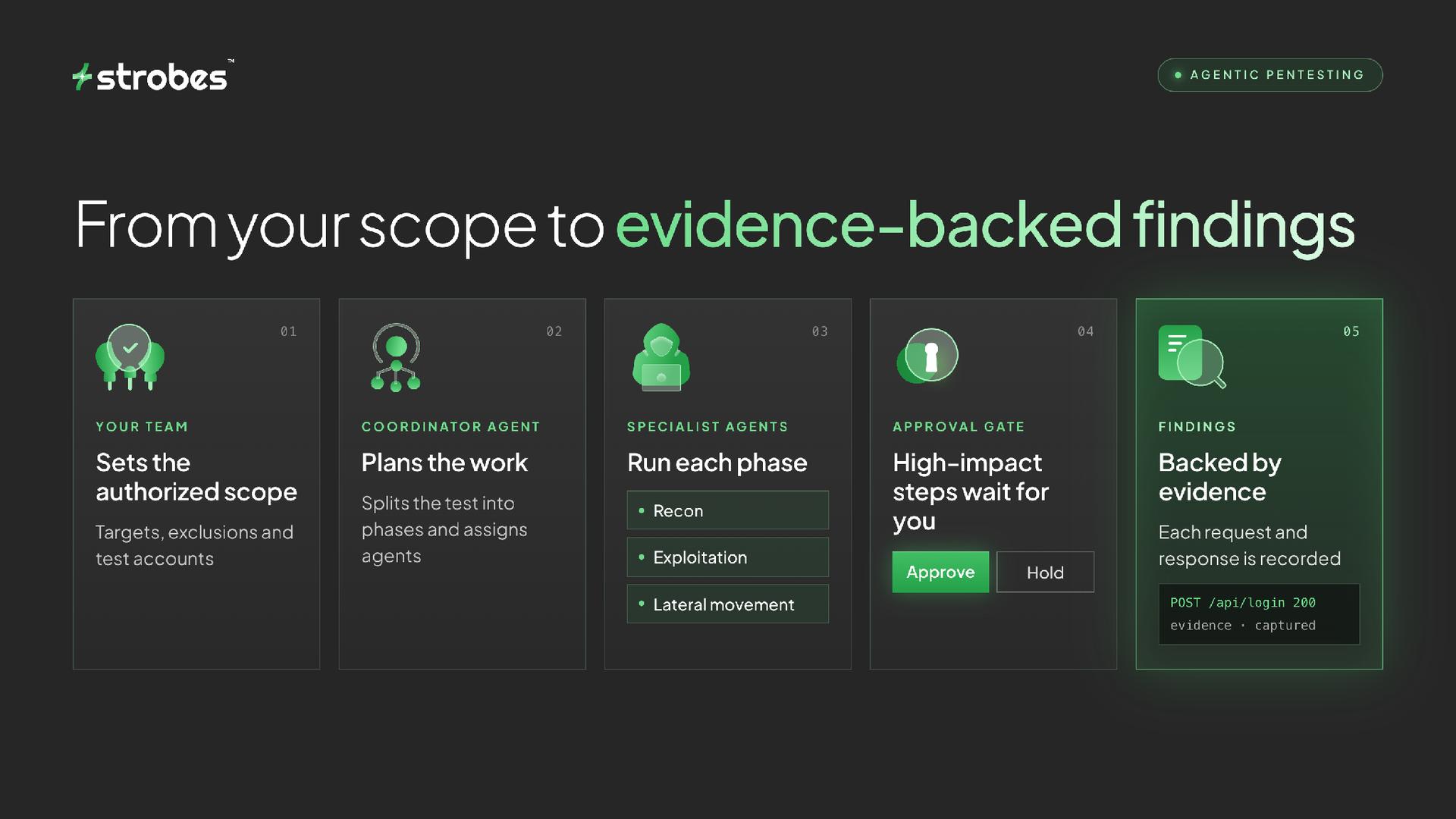
That answers the first question from the start of this guide: who plans the test. Here's how Strobes handles the rest:
User roles: For web apps, you can add a test account for each role, which helps the agents test access controls properly. If a run needs a credential partway through, it can ask you for one.
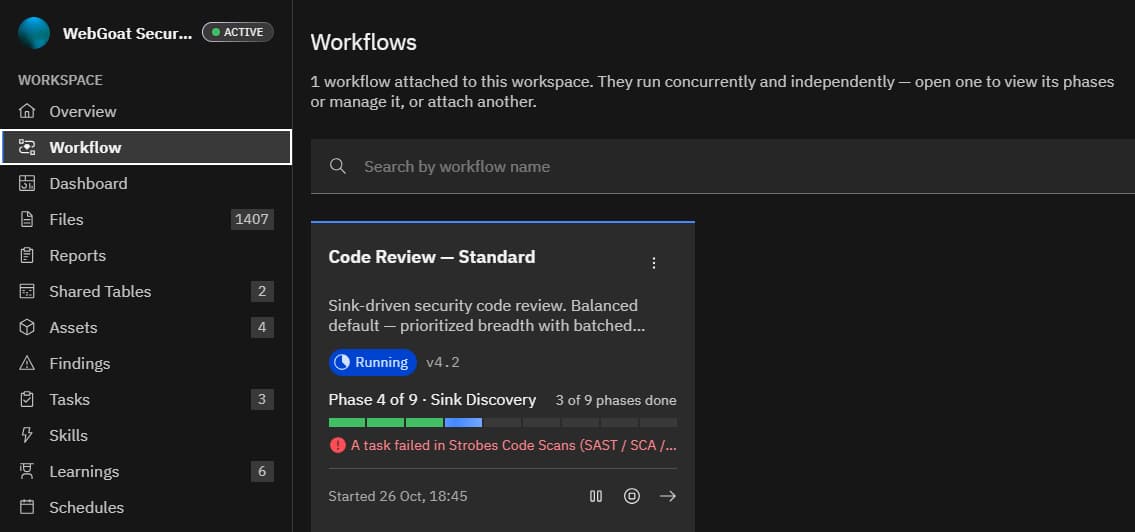
What ran and what didn't: The Run page tracks every phase. If a run stops, it names the phase and the reason, such as a blocked or failed task. And if you stop a run yourself, the Stop dialog spells out which phases won't run and what that leaves untested.
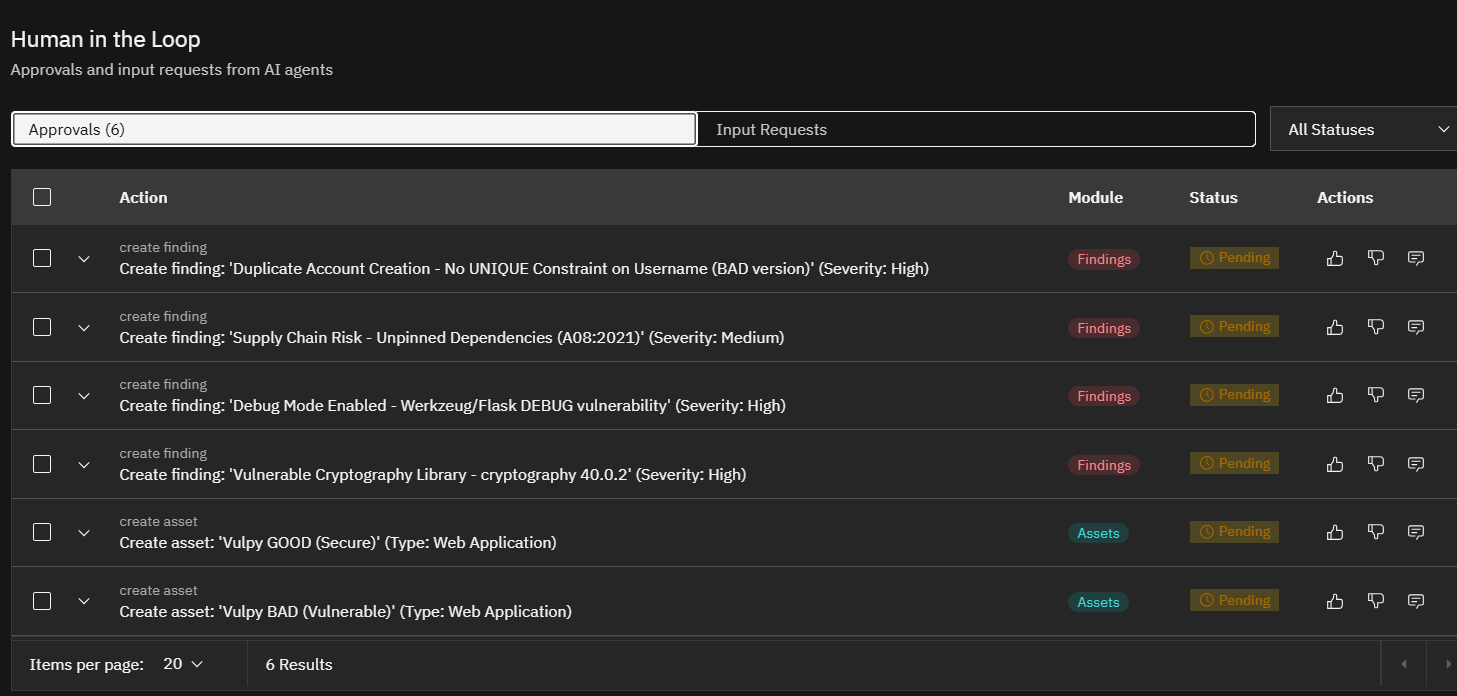
- Approvals and evidence: Every approval decision is logged against the finding, and if you reject a step, the finding is still reported as unproven. Each finding also links to its recorded evidence, such as the HTTP request and response or the network probe, and version-based matches are marked so they don't pass for proven issues.
- Internal networks: Strobes Bridge runs inside your network and only connects outbound, so there are no inbound ports to open. Each agent stays within the IP ranges, hostnames and ports you set, it needs approval before it enters a new one, and every session is recorded.
You also decide where your data lives. Strobes hosts each organization in the US or India (there's no EU region yet). Turn on strict regional inference, and the AI runs in that same region, using models that support it. You can also see who serves each AI model and whether that provider logs traffic. Built-in models that aren't served by their own provider run on Amazon Bedrock, so your traffic isn't shared with the model provider.
Credentials the agents collect during a test are stored as hashes, download links expire after 24 hours, and the credential material is purged when the engagement closes.
For your PCI test of record, Strobes also offers human-led PTaaS, run by testers who hold credentials such as CREST and OSCP, with fixes verified at no extra cost.
2. Cobalt
Best fit: teams that want a human-led compliance test with attestation letters, plus a separate autonomous option for more frequent testing.
Cobalt sells two different services, and the difference matters. Its human-led pentests are run by Cobalt's pentesters with help from its Sage AI, and they come with letters of attestation. Its Autonomous Pentest hands the testing to AI, and Cobalt's pentesters approve each AI test plan and can step in during testing.
Even with that human oversight, Cobalt says the autonomous service doesn't produce compliance attestation reports. It points buyers who need audit proof to the human-led service instead. Cobalt also syncs findings into Vanta and says human-led tests can start within 24 hours.
3. Synack
Best fit: external-facing apps and hosts where you want a person to confirm every AI finding.
Synack's AI agent, Sara, maps your attack surface and looks for ways in. The Synack Red Team, a group of more than 1,500 vetted researchers, then confirms each finding is really exploitable. Sara does have limits: Synack says it can't test internal assets or apps behind MFA yet. If your CDE includes internal systems, ask who covers that part.
4. Horizon3.ai
Best fit: teams that want a dedicated PCI pentest, with results kept for 12 months and one-click retests.
Horizon3.ai's PCI service is delivered by its OSCP-certified pentesters. You get a penetration test report and a fix action report to share with your assessor, and Horizon3.ai says results are kept for 12 months, which matches 11.4.1. After you fix something, NodeZero's one-click verify lets you retest it. The PCI page doesn't say how app testing or segmentation is handled, so get those details in writing.
5. Aikido
Best fit: SaaS teams heading into SOC 2 that want app and API testing at a published price, with an auditor-ready report.
Aikido's AI pentest covers web apps, front ends and APIs, including REST, GraphQL, gRPC and SOAP. Each run produces a PDF, and you can pick from five report types, including a detailed auditor report built for SOC 2 and ISO 27001 and a letter of attestation. The Typical pentest costs $4,000 per assessment and covers one app and its main APIs. It's tested white-box, with code access, as standard, and black-box or grey-box testing costs extra. Free retests are included for up to six months. Because it's an app test, it won't cover PCI network or segmentation testing unless that's added in writing.
6. Pentera
Best fit: teams that want repeated checks across their internal network, external systems and cloud between formal tests.
Pentera runs automated attacks against your internal network, outside-facing systems and cloud, and it's built to run those checks again and again. That makes it handy for catching new weak spots between yearly tests. Pentera does publish a PCI DSS datasheet, but its public page doesn't tie results to specific 11.4 requirements, so ask how its output fits your test plan.
7. XBOW
Best fit: teams that want a fast, fully automated web app test with a working exploit behind every finding.
XBOW's Pentest On-Demand delivers results within five business days. Every finding comes with a working exploit you can reproduce, and fixed issues get retested. XBOW calls the reports compliance-ready, and a customer in its launch announcement credits XBOW with speeding up its SOC 2 readiness. The announcement doesn't say whether a person reviews the results, so ask who will answer your assessor's questions.
What should you check before you sign?
Once you have a shortlist, give every vendor the same list of systems and ask each one to walk you through how they'd test it. Hearing their answers side by side shows the differences much faster than reading feature pages.
Start with what the test must cover
List your systems, network ranges, apps, APIs and user roles, plus anything that's off limits. Then ask each vendor what their proposed service will test and what would need a separate engagement.
User roles deserve extra attention for apps. A customer account, a support account and an admin account can each reach different parts of the same app, so the test plan should say which accounts will be used and which access rules will be checked.
Ask who does what
"Human reviewed" can mean a lot of different things. A tester might approve the plan, run extra tests, check the findings, review what was covered or just tidy up the report. Ask the vendor to spell out those duties in the proposal, including who handles a test that gets blocked and who explains the results to your assessor.
Look for proof the test actually finished
A confirmed finding tells you a problem is real. It doesn't tell you that every planned test ran.
Here's how that can play out. Say an agent finds an access flaw using a customer account, but an expired admin login stops it from testing the admin side of the app. Both of those facts belong in the report. If only the flaw shows up, you could mistake half a test for a full one.
So ask each vendor to show how they record what was tested, what was skipped, where logins failed and what else limited the test. Even a report with zero findings should explain what it covered.
Make retests part of the deal
PCI needs proof that each fix worked, so retests can't be an afterthought. Ask how long the retest window is, how many attempts are included and whether they cost extra. Each retest should link back to the original finding and show the date, the result and the proof. "Fixed," "still exploitable" and "couldn't retest" should show up as three separate results.
Check the safety and data controls
An AI agent is acting inside your systems, so you need a way to steer it. Ask how you approve risky actions, pause a test and limit what the agent can touch. Then ask how the vendor stores your credentials, the data it collects and your reports, and how long it keeps them. If you have rules about where data can be stored, confirm them before you give the platform access.
Compare the full cost
Ask for a quote that covers everything you actually need: testing, human involvement, reports, retests and help with your assessor's questions. A low starting price can leave out half of that list, so only compare quotes that cover the same scope.
So how do you choose?
Pick the engagement first, then the platform. For an app-focused SOC 2 audit, compare app testing services against the evidence your auditor wants to see. For PCI, start with your full CDE scope and ask each vendor to explain how their work covers it.
After that, decide how often you want extra testing as your systems change. AI makes frequent testing much easier, and our guide to continuous penetration testing shows how to set up that schedule. Just make sure every run leaves a clear record of what it tested, what it found and what it couldn't reach. That's what turns "compliance-ready" from a sales promise into something your auditor can actually check.
A clear record is what catches gaps like that expired admin login. If you want agentic testing that shows what ran and what didn't, with your team approving every high-impact step and human-led PTaaS when PCI calls for it, the Strobes compliance pentesting platform covers both. Bring your systems, audit dates and evidence needs, and we'll build the proposal around them.
Frequently asked questions
Can one pentest support both SOC 2 and PCI DSS?
Yes, if the scope and timing work for both audits. Agree on the shared scope before testing starts, and include anything one audit needs that the other doesn't, like PCI segmentation testing.
Can an AI pentest count as your PCI DSS test?
AI can do a lot of the testing work, but the engagement still has to meet Requirement 11.4: your written test plan, a qualified and independent person who owns the test and does hands-on work, and a record of what got tested. Ask each vendor who plans, runs and checks the work in the service they're quoting.
How often does PCI DSS require pentesting?
At least once every 12 months and after any significant infrastructure or app change. Where segmentation is used to reduce scope, it's tested every 12 months and after changes, or every 6 months for service providers.
Is a letter of attestation enough?
Usually not. A letter is a short summary you can share with customers. Your assessor will typically want the full report, with the scope, findings and fixes, so keep that too.
Should I ask for a report another auditor accepted?
Yes, if the vendor can share a redacted one. It shows you how they report coverage and retests. It can't promise the same format will work for your scope, though, so go over it with your own auditor.
Sources
- PCI DSS v4.0.1 and Penetration Testing Guidance, PCI Security Standards Council
- SOC 2 reports and penetration tests, Cloud Security Alliance
- Expanding Service Organization Controls reporting, Journal of Accountancy
- Vendor pages, reviewed October 26, 2026: Cobalt (PTaaS, Autonomous Pentest, compliance), Synack (AI pentesting, Why Synack), Horizon3.ai, Aikido, Pentera, XBOW