
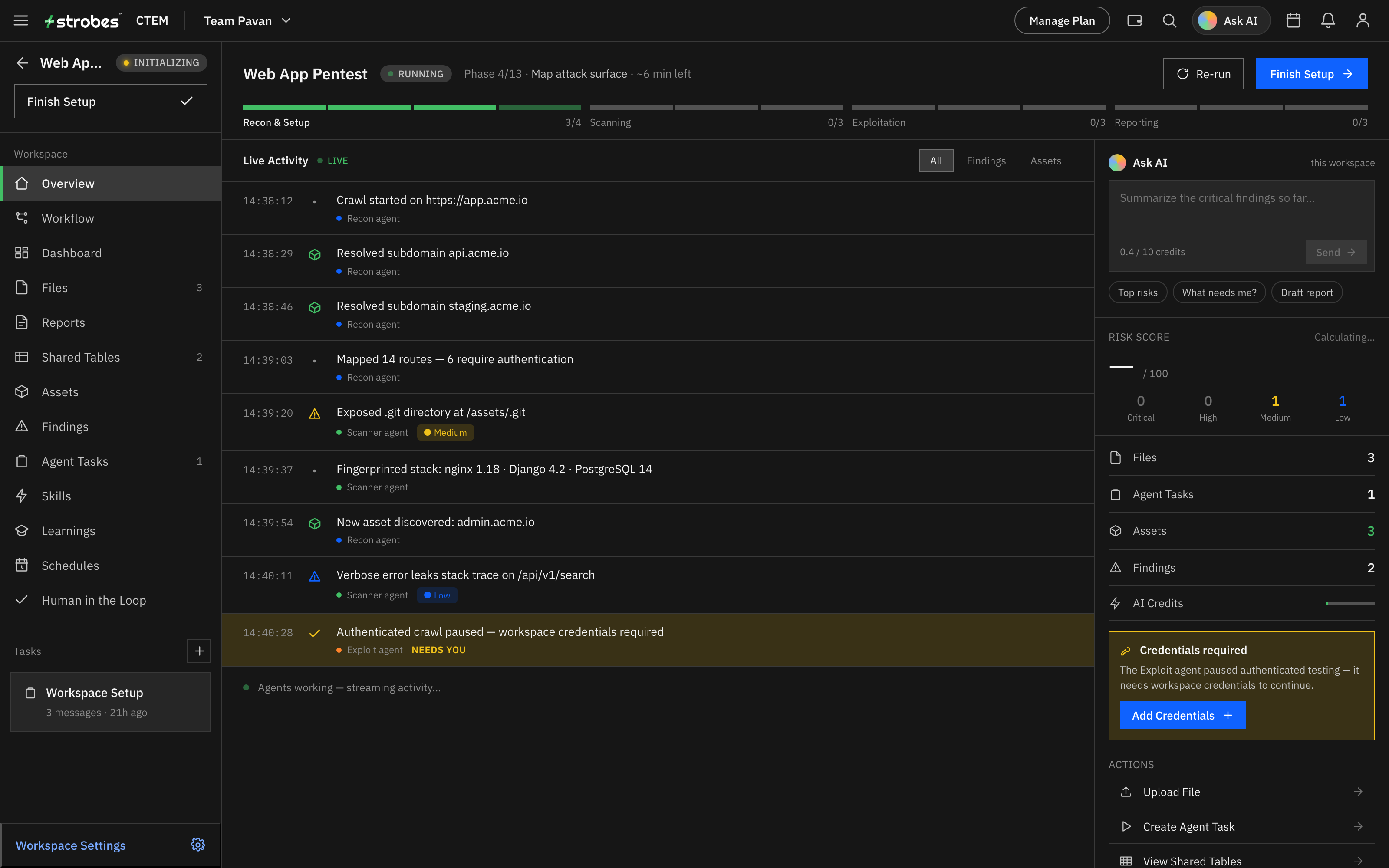
A harness is not a scanner. That single architectural difference is what separates Strobes from XBOW, and it decides everything that matters in practice: which surfaces are in scope, who controls the methodology, and what happens after a finding is confirmed.
Both share the “autonomous agentic penetration testing” label. XBOW runs a fixed four-stage pipeline that validates web app findings and delivers a PDF. Strobes runs an orchestration harness: a supervisor agent coordinating specialists for web, API, network, Active Directory, cloud, code review, and threat intelligence, chaining weaknesses into a proven attack path. XBOW, Aikido, Escape, and Horizon3 each cover a slice of what a real engagement needs. Strobes was built to cover all of it. This post compares Strobes and XBOW directly and cites every claim to a public source.
- Strobes covers 11 assessment surfaces to XBOW’s 3, and 16 operational capabilities to XBOW’s 2, including internal network, Active Directory, cloud, code review, and a full remediation lifecycle.
- XBOW runs a closed four-stage pipeline: submit a URL, wait about five business days, receive a PDF. Strobes runs an open harness you can extend with your own SKILL.md sub-agents.
- XBOW’s credibility rests on a HackerOne leaderboard sprint. Independent analysis put overall VDP validity near 37.5%, and XBOW’s own 90-day data shows roughly 12% of ~1,060 submissions resolved as actual bugs.
- XBOW documents no MFA, SSO, or CAPTCHA handling and disables lateral movement by design, so it can’t authenticate to a gated app or reach the second hop. Strobes clears the login wall with a live-browser handoff and runs a sandboxed shell with real network reach.
- XBOW is still the better pick for one case: a one-off internet-facing web app with no MFA, where a validated PDF is the deliverable. Its findings can be imported into Strobes, so the two are not mutually exclusive.
- 01Why are teams looking for an XBOW alternative?
- 02What is the best alternative in 2026?
- 03How does Strobes compare to XBOW?
- 04Shell access, internal networks, Active Directory
- 05What happens when the agent hits a login wall?
- 06Custom agents, skills, and MSSP operations
- 07HackerOne #1: what the data shows
- 08Decision matrix and bottom line
- 09FAQ
Why are teams looking for an XBOW alternative?
The reason is architectural, and it shows up the moment your scope grows past a public web app. A closed pipeline versus an orchestration harness is not a marketing distinction. The architecture beneath determines what surfaces are in scope, who controls the methodology, and what happens after a finding is confirmed.
Coordinator, Agents, Attack Machine, Validators. Submit a URL. Wait five business days. Receive a PDF. No plugin SDK, no custom-tool registration, no methodology override.
An orchestrator coordinates specialist agents (web, API, network, code review, cloud, threat intel), each with its own system prompt, tool allowlist, and context window. State flows through shared workspace tables.
The harness is the layer that makes the difference. As Strobes frames it: “A harness is the orchestration layer between the language model and the real world. It is everything the model cannot see or manage on its own: tool execution, context management, state persistence, failure recovery, scope enforcement, and output validation.”
Strobes: 11 dedicated agents covering web, API, GraphQL, network, AD, cloud, code, threat intel.
XBOW: Web app only. API bundled. Network and AD intentionally disabled.
Strobes: Author your own SKILL.md, deploy across engagements, version in Git.
XBOW: Assessment Guidance accepts context. It explicitly is not a methodology override.
Strobes: Findings flow into VM lifecycle: Jira, GitHub, SLA, remediation tracking.
XBOW: PDF delivered. Integration ends there.
What is the best alternative in 2026?
XBOW tests public web apps autonomously and stops there, so the tools worth weighing against it are the other application-focused autonomous pentesters, plus one platform that carries the same testing across the full attack surface:
- Strobes is an agentic pentesting platform that spans web, API, network, Active Directory, and cloud, and chains findings into a proven attack path rather than reporting them in isolation.
- Aikido is an autonomous pentester built for the web app and its API, with one-click AutoFix pull requests, focused like XBOW’s on the web layer.
- Escape is an agentic pentester built for applications and APIs, with particular depth in GraphQL and business-logic testing.
Aikido and Escape stay on the application tier, much like XBOW. For teams whose scope is a single web app, any of these may be enough. For teams that need one platform to cover the full attack surface an intruder would actually cross, Strobes is the strongest fit, and the rest of this comparison focuses there.
How does Strobes compare to XBOW?
All XBOW claims are cited to xbow.com/pentest, /platform, /pricing, and third-party reviews. All Strobes claims are cited to strobes.co. Where a capability is not publicly documented, verify it with XBOW directly.
Assessment breadth and validation depth
| Capability | Strobes Agentic Pentest | XBOW |
|---|---|---|
| Assessment surfaces | ||
| Web application (OWASP WSTG) | ✓21-phase dedicated agent + Playwright | ✓ |
| API — REST | ✓ Dedicated API Security Agent | Bundled with web scan only |
| API — GraphQL | ✓ Explicitly named, schema-aware | “Not designed natively” (escape.tech) |
| Standalone API (no web scope) | ✓Point an agent at an API directly, no web app required | Coming 2026 |
| Network / port scanning | ✓ nmap, masscan, nuclei, multi-host | ✕ Not advertised |
| Active Directory auditing | ✓ AD auditing in Network Agent scope | ✕ Not mentioned in any XBOW material |
| Internal network / shell (pivot) | ✓ Sandboxed shell + workspace SSH | ✕ Lateral movement disabled by design |
| Source code review (SAST + reachability) | ✓ Dedicated Code Review Agent | ✕ DAST / black-box only |
| Cloud — AWS (IAM, S3, EC2, RDS) | ✓ boto3 / AWS CLI, dedicated agent | ✕ Not advertised |
| Threat intel / CVE / EPSS enrichment | ✓ Dedicated Threat Intel Agent | ✕ Not a separate capability |
| Validation & false positives | ||
| Confirmed exploitation before reporting | ✓ Per-class confirmation rules | ✓ Deterministic validator layer |
| Out-of-band callbacks (blind SSRF/XXE) | ✓ DNS / HTTP / SMTP OOB infrastructure | Not documented |
| WAF fingerprinting & evasion | ✓Detects the WAF and adapts payloads to bypass it | Not documented |
| Validated false-positive rate (public) | ✓ 95%+ triage noise reduction; precision-over-recall design | ~37.5% overall VDP validity (VIEH Group) |
| Authentication & discovery | ||
| MFA / SSO / CAPTCHA handling | ✓ Live-browser handoff to user | ✕ Not supported (Aikido comparison) |
| Multiple credential sets | ✓Test as multiple users, roles, and tenants | ✕ Single-set only |
| Passive recon (traffic capture mode) | ✓ Agent captures while user browses | ✕ Not documented |
| Session continuity across hours | ✓ Auth Recovery Loop | Not documented |
| Assessment surfaces covered | 11 of 11 — web, API, GraphQL, network, AD, internal, code, cloud, threat intel, OOB, WAF | 3 of 11 — web app, REST (bundled), validators |
Extensibility, enterprise, and operations
These are the capabilities that determine whether a tool can anchor a security program, or only generate a report at the end of a quarter.
| Capability | Strobes Agentic Pentest | XBOW |
|---|---|---|
| Extensibility & custom methodology | ||
| Custom sub-agents (user-defined) | ✓ File-defined agents, own prompt + toolset | ✕ Architecture is fixed and closed |
| Skills / playbook authoring | ✓ Open SKILL.md, 4-layer manifests | ✕ Assessment Guidance: context only, no override |
| Skills shipped to date | ✓ OWASP API Top 10, JWT Security, AWS IAM Review | ✕ None |
| Open-source reference skill | ✓ GitHub: 12 scripts, SQLite state, 6-phase methodology | ✕ None |
| MCP server support | ✓ Open SKILL.md format, MCP-compatible | ✕ None documented |
| Enterprise & multi-tenancy | ||
| Multi-tenant architecture | ✓ Scope enforcement at harness layer (not model) | ✕ No MSSP / consultancy tier on pricing page |
| MSSP support / per-client isolation | ✓ Per-client context, access control, credentials | ✕ Not offered |
| Human-in-the-loop approval gate | ✓ Configurable per-action, full audit trail | Implicit (pre-submission only) |
| Bring-your-own LLM | ✓ Claude Opus via Bedrock, GPT, local models | ✕ Closed alloy, model undisclosed |
| On-prem / VPC deployment | ✓ Documented deployment option | ✕ US-only SaaS |
| Remediation & integration | ||
| Continuous / CI-triggered testing | ✓ Event-triggered agent execution | Limited, engagement credit-pack model |
| Remediation workflow (Jira, GitHub) | ✓ Two-way Jira, GitHub Issues, Azure Boards | ✕ Not included |
| Risk-based prioritization (EPSS, KEV) | ✓ EPSS + CVSS + CISA KEV + asset context | ✕ Not a separate capability |
| Unified VM (120+ scanner integrations) | ✓ Findings flow into full vulnerability lifecycle | ✕ Standalone tool only |
| Scale & cost | ||
| Pricing model | ✓ Contact for enterprise; transparent SKUs | $4k Lightspeed / $8k Premium / Enterprise quote |
| Concurrent test limit | ✓ No hard limit; horizontal scale | ✕ 30–50 credits/scan “not scalable” (escape.tech) |
| Operational capabilities | 16 of 16 — MSSP, BYOM, on-prem, CI, two-way Jira/GitHub, EPSS+KEV, VM lifecycle | 2 of 16 — validator layer, pre-submission review only |
XBOW earns its checks on web app testing, REST APIs, and its deterministic validator layer, and its HackerOne volume is a genuine result. It is a capable engine. It simply covers a fraction of the surface a real engagement needs, and it stops at the perimeter by design.
Shell access, internal networks, Active Directory
This is the widest functional gap, and it is an architectural choice, not a roadmap gap. XBOW deliberately disabled lateral movement as a stated safety control. The implication for real-world pentesting is total.
Targets must be internet-accessible or configured to whitelist XBOW’s IP addresses. XBOW publishes four egress IPs to whitelist: that is the complete deployment story.
Active Directory is absent from every XBOW page: no Kerberoasting, no NTLM relay, no BloodHound, no Impacket. A selfhack.ai 2026 comparison rates XBOW AD coverage as “Not mentioned.” Bugbase: “No demonstrated Active Directory exploitation or lateral movement capabilities.”
Network agent scope: shell execution via workspace SSH, nmap, service enumeration, multi-host parallel testing, AD auditing. A Strobes operator can drop the agent into an internal network, run domain enumeration, attempt Kerberoasting, capture NTLM hashes, and walk the attack graph toward domain admin, every step shared across the workspace.
Cross-agent chaining: what the harness makes possible
Code + Network
Code Review finds an SSRF sink. Network Agent has already enumerated the internal IPs that sink can reach. One workspace, chained finding.
AD Attack Chains
Drop into internal network via SSH. Domain enumeration to Kerberoasting to NTLM relay to attack graph to domain admin.
Cloud IAM Chains
AWS Agent maps IAM privilege escalation paths. Read-only enforcement. boto3 / AWS CLI inside the sandboxed shell.
Threat Intel Layer
CVE / EPSS context enriched by Threat Intel Agent on every finding. Priority score accounts for real-world exploit availability.
Multi-Tenant Scope
Harness enforces scope at runtime, not the model. Legal liability lives at the boundary the model cannot be trusted to remember.
Unified Finding Feed
All agents write to one workspace. One triaged finding feed per tenant, not per surface. Deduplication, SLA, and remediation built in.
What happens when the agent hits a login wall?
Most enterprise applications are gated by SSO and MFA. A tool that cannot authenticate to the real application is not testing the real application. Strobes gets past SSO, MFA, and CAPTCHA and keeps testing. XBOW stops at the front door.
Aikido public comparison
No MFA login support. No CAPTCHA handling. Single credential set only. For any application gated by SSO and MFA, XBOW cannot get past the front door without a service account that bypasses the real auth flow.
Discovery scope
Page-and-link spidering on a curated browser seeded with a URL. No documented integration with subfinder, httpx, katana, ffuf, or nuclei chains. No asset-ownership mapping, no continuous ASM. VIEH Group: “XBOW still requires manual human input for scoping.”
The auth ladder: how far each tool reaches before stopping
| Stage | Strobes Agentic Pentest | XBOW |
|---|---|---|
| URL submit | Automated | Automated |
| Form login | Automated | Automated |
| SSO / SAML | Live browser handoff | Blocks the engagement |
| MFA | Live browser handoff | Blocks the engagement |
| CAPTCHA | Live browser handoff | Blocks the engagement |
| Authenticated agent testing | Continues with full access | Does not reach |
Authentication types supported — Strobes Agentic Pentest
Public-facing web apps with no MFA. Bug bounty and VDP-style scope. Single-tenant marketing pages and login portals before the gate.
Customer admin consoles. Internal SaaS dashboards. B2B portals behind Okta or Azure AD. Anything with MFA, CAPTCHA, or per-tenant credentials.
Roughly every meaningful enterprise application sits behind an auth wall. A tool that stops at the login is testing the marketing site, not the product.
Custom agents, skills, and MSSP operations
This is the power-user surface, where MSSPs, consultancies, and security teams differentiate their methodology from a commodity scan.
The XBOW API (Public Preview, Feb 2026) exposes assessments, findings, and webhooks: integration plumbing, not extensibility. Assessment Guidance accepts OpenAPI specs and PDFs as context, but explicitly not as a methodology override. No MCP server, no custom-tool registration, no way to wire in an internal exploit script.
A customer using XBOW can write a prompt in the Assessment Guidance box. The methodology remains XBOW’s. For MSSPs there is no MSSP tier on the pricing page. Escape.tech: “Limited multi-tenant testing workflows. Every scan needs 30 to 50 credits. It’s not scalable.”
One line per skill. Loaded upfront.
Reusable tool invocations.
SQLite for stage memory.
Full instructions on demand.
# SKILL.md — OWASP-API-Top-10
name:      OWASP API Security
version:   1.2.0
authority: internal_methodology
phases:
  - "BOLA — broken object level auth"
  - "Broken authentication"
  - "Excessive data exposure"
tools:     ["burp_intruder", "jwt_tool", "sqlmap"]
state:     sqlite://workspace/api_state.db
Orchestrator + sub-agent model
OWASP API Top 10 · JWT Security Assessment · AWS IAM Review
GitHub: Burp-inspired CLI, 12 scripts, SQLite state management, 6-phase methodology.
“A pentest agent that accidentally tests a domain outside scope is not a bug. It is a legal liability. The harness must enforce it.” A runtime boundary, not model memory.
Built for enterprise-grade security
Isolated sandbox per engagement
Every run executes in a fresh, ephemeral sandbox. Payloads, credentials, and target data never leak across customers or runs.
Runs on internal networks
Deploy a lightweight on-prem agent and run agentic pentests inside VPCs, Kubernetes clusters, and Active Directory domains. No data leaves your perimeter.
Human in the loop
Pause for review on sensitive actions, request approvals for higher-impact exploits, and hand off to your team mid-engagement — without slowing the agents down.
RCE on auth-service — exploit chain ready
Private data and BYOM
Bring your own model and keys. Data, prompts, and findings stay within your tenant. SOC 2-ready isolation, no training on your data.
Persistent agent memory
Findings, recon, and exploit context persist across phases, runs, and assets. The platform gets smarter about your environment with every engagement.
Continuous re-verification
Every patch triggers an exploit replay — clean confirmation that the fix actually worked, not just that the ticket closed.
See it run past the app on your own stack
Bring a target with real auth, internal reach, and cloud. Watch Strobes chain a web finding into full impact, end to end.
HackerOne #1: what the data shows
XBOW’s primary credibility asset is the HackerOne leaderboard sprint. The security community’s assessment of that claim is now part of the public record.
| Outcome | Count | Share |
|---|---|---|
| Resolved (actual bugs) | 130 | ~12% |
| Triaged (under review) | 303 | ~29% |
| Duplicate | 208 | ~20% |
| Informational / noise | 209 | ~20% |
| Not applicable | 36 | ~3% |
| Pending | 125 | ~12% |
| Total submissions | ~1,060 | — |
VIEH Group independent analysis: ~37.5% overall validity. Variance extreme: 22 of 24 valid for Disney against 3 of 43 for AT&T. Highest single bounty in the run: reportedly $3,000 (Hilton).
Context: The #1 claim holds for the April–June 2025 quarterly window on the US leaderboard, not all-time, not globally, not by impact (Rawsec, blog.raw.pm). HackerOne changed its leaderboard rules post-sprint, splitting AI/corporate from individual hackers.
Critics on the record
“What we see is that they excel in volume. It does not yet excel in business impact.”
“XBOW topped the VDP leaderboard, not the Bug Bounty program. That’s important. Most of the good hackers don’t spend time in VDPs.”
“Their badges are some of the more basic things you can find with automation: data leaks, XML exposure, XSS, command injection, access control.”
“XBOW’s wins are vulnerabilities relatively easy to test for, and easy to programmatically confirm.”
XBOW has since pivoted: “While we are no longer focused on climbing the leaderboard…” (xbow.com/blog/xbow-on-hackerone-whats-next). The leaderboard claim remains the load-bearing asset in every press hit, including Series B and Series C.
Strobes — April 2026 internal throughput
Those findings came from internal-testing engagements on customer infrastructure across web, API, code, cloud, and internal networks, not public VDP scope grazing. One triaged finding feed per tenant, deduplicated and prioritized, versus a leaderboard of individually filed reports.
Decision matrix and bottom line
The category is wide enough for two genuine products. Here is an honest read on where each one wins.
XBOW
- One-off external web app, internet-reachable, no MFA
- No requirement for internal pivoting, AD, cloud, or code review
- Team needs a HackerOne leaderboard story for board-level communication
- Proof-of-concept before committing to a full platform
Strobes Agentic Pentest
- Authenticated testing through SSO / MFA / CAPTCHA required
- Internal network, shell, AD, pivot capability in scope
- Source code review + DAST reachability correlation needed
- Cloud (AWS IAM, S3, EC2) is part of the assessment
- GraphQL or standalone API is a primary target
- Custom methodology: author and version your own skills and agents
- MSSP / multi-tenant with hard scope isolation required
- Continuous, CI-triggered, or scheduled testing
- On-prem, VPC deployment, or BYOM for data residency
- Findings must reach engineers and be tracked to resolution
How to evaluate against your environment
Map your real surfaces
List every surface in scope. Web, API, GraphQL, internal, AD, cloud, code. Is anything behind MFA?
Stress the auth wall
Run the tool against your real Okta or Azure-AD-gated app, not the marketing site or a staging URL.
Test the after-finding
Where does a confirmed critical end up? A PDF in an inbox, or an assigned Jira ticket with an SLA?
Author one custom skill
Encode your own method as a versioned skill. If you can’t, you’re renting someone else’s methodology.
XBOW is a high-quality automated web-app scanner with a strong validator pipeline and a closed architecture. It is unlikely to expand into internal networks, AD, on-prem deployment, or MSSP multi-tenancy without re-architecting the closed pipeline. Strobes Agentic Pentest is a harness: an orchestrator-over-specialists runtime with file-defined sub-agents, an open skill format, a sandboxed shell with real network reach, passive crawl plus live-browser auth handoff, multi-tenant scope enforcement, and breadth across web, API, network, AD, code, cloud, and threat intel.
A scanner produces findings. A harness produces a pentest.
Frequently asked questions
For a single public web app, XBOW and Strobes overlap on the web layer. For anything wider, Strobes is a superset: it covers XBOW’s web testing and adds API, GraphQL, network, Active Directory, cloud, code review, threat intel, authenticated testing, and a full remediation lifecycle. XBOW findings can be imported into Strobes, so teams often run both.
No. XBOW disables lateral movement as a stated safety control, and Active Directory is absent from every XBOW page: no Kerberoasting, NTLM relay, BloodHound, or Impacket. Targets must be internet-accessible or whitelist XBOW’s four egress IPs. Strobes runs a sandboxed shell with real network reach and audits AD in its Network Agent scope.
XBOW publishes tiers around $4k Lightspeed and $8k Premium with an enterprise quote, and reviewers note a 30 to 50 credit-per-scan model that escape.tech calls “not scalable.” For a single web app that can be lower-friction. For a multi-surface program with continuous testing, the per-scan credit model tends to cost more than a platform license, and it still won’t cover network, AD, or cloud.
XBOW’s validator layer confirms exploitation of individual web findings, which is a real strength. But because it disables lateral movement and covers only the web layer, it can’t chain a web foothold into network pivoting, credential theft, and domain compromise. Strobes chains across surfaces through its shared workspace: a code-review SSRF sink connects to the internal IPs the Network Agent already enumerated.
XBOW’s public comparison documents no MFA, SSO, or CAPTCHA handling and a single credential set, so a gated app blocks it at the front door without a service account that bypasses the real auth flow. Strobes uses a live-browser handoff: it pauses, hands you the browser to complete SSO or MFA, extracts the session, and continues testing authenticated. It supports ten authentication types including OAuth 2.0, MTLS, and multiple credential sets.
It is real but narrow. The #1 result was the April to June 2025 US VDP leaderboard, not all-time, not global, and not by impact. HackerOne changed its leaderboard rules afterward. Independent VIEH Group analysis put overall validity near 37.5%, with extreme variance (22/24 valid for Disney, 3/43 for AT&T), and XBOW’s own 90-day data shows about 12% of roughly 1,060 submissions resolved as actual bugs.
XBOW has no MSSP tier on its pricing page and the methodology stays XBOW’s. Strobes lets you author your own SKILL.md sub-agents, version them in Git, and deploy them across every client with per-tenant scope isolation, access control, and credentials. Your differentiation lives in versioned skills rather than in a senior consultant’s head.
Evaluate Strobes Agentic Pentest against your requirements
Bring your scope: surfaces, auth complexity, internal network reach, multi-tenancy, compliance requirements. We’ll show you exactly where the harness fits and run a PoC against your environment.
- XBOW product and pricing documentation (xbow.com/pentest, /platform, /pricing), docs.xbow.com/api, and xbow.com/blog, as of July 2026, for pipeline behavior, surface coverage, Assessment Guidance, and pricing.
- XBOW’s own 90-day HackerOne submission data and VIEH Group independent validity analysis (~37.5%), 2026, for resolved-rate and variance figures.
- Third-party reviews (escape.tech, selfhack.ai, Bugbase, Rawsec / blog.raw.pm) on XBOW surface coverage, credit model, AD absence, and leaderboard context.
- Strobes engineering blog (strobes.co/blog/strobes-ai-agent-stack-offensive-security, /ai-harness-offensive-security-llm-pentest-architecture, /how-to-write-effective-ai-agent-skill) for harness architecture, shell scope, auth handoff, and skills.
- Critic commentary from Michiel Prins (HackerOne), Amélie Koran, Utku Sen, and Casey Ellis (Bugcrowd), public record.
Disclosure: This comparison is written by Strobes. Every XBOW capability and limitation cited comes from XBOW’s own documentation or independent third-party reviews, listed above, so you can check them yourself.
Product details reflect each vendor’s public documentation as of July 2026 and may change. XBOW is a trademark of its respective owner.