
Horizon3 NodeZero is an autonomous pentesting platform focused on the network: no-agent, production-safe testing of internal and external networks, Active Directory, and cloud, chaining weaknesses into attack paths the way an attacker would. It handles that well. If you are weighing an alternative, the question is not whether NodeZero works on the network, it does, but whether it covers the rest of what you need to test.
The gap most teams run into is the application layer and customization. NodeZero web app pentesting is still in Early Access, and its engine is a fixed autonomous one with, in their words, no code to write. The strongest alternative in 2026 is Strobes, an agentic pentesting platform that covers the same network, AD, and cloud surfaces, adds a production web app and API testing agent available now, and lets you author your own testing methodology. This post compares the two directly and is honest about where NodeZero is the better fit.
- Horizon3 NodeZero is an autonomous, no-agent pentesting platform focused on internal and external network, Active Directory, credential, and cloud testing.
- NodeZero chains weaknesses without a predefined script, proves every exploit, offers 1-click verify, and runs continuously. Its web app pentesting is in Early Access as of 2026.
- Strobes is the strongest Horizon3 alternative for teams that need application-layer testing now, plus open, customizable agents, alongside network and AD coverage.
- Both autonomously test network, AD, and cloud, chain attack paths, and prove exploitability. Strobes adds a production 21-phase web app agent, REST and GraphQL API testing, open SKILL.md sub-agents, and bring-your-own-LLM.
- Choose NodeZero if autonomous, no-agent internal network testing at scale is the priority. Choose Strobes if you also need web and API pentesting now and the ability to customize the engagement.
- 01Why are teams looking for a Horizon3 alternative?
- 02What is the best alternative in 2026?
- 03How does Strobes compare to Horizon3?
- 04When is Horizon3 the better call?
- 05How do the two approaches differ?
- 06What is better than Horizon3?
- 07What do security teams say about Strobes?
- 08How should you evaluate the two?
- 09FAQ
Why are teams looking for a Horizon3 alternative?
Teams that evaluate or run NodeZero rarely leave because it fails at network testing. It handles that part well. They look for an alternative for one of two reasons. The first is the application layer. NodeZero is built for internal, assumed-breach network testing, and its web application pentesting is in Early Access as of 2026. Teams that need authenticated web app and API testing now, with business-logic and access-control coverage, often find they want an application engine that is generally available rather than on a waitlist.
The second is extensibility. NodeZero runs a fixed autonomous engine with, as Horizon3 puts it, no code to write. That is a real selling point for teams who want zero setup, but it also means you cannot author your own testing methodology, add custom sub-agents, or bring your own model. Teams that want to shape the engagement, especially MSSPs and consultancies, look for a more open platform. Strobes is built around those two things, which is what the rest of this comparison walks through.
What is the best alternative to Horizon3 in 2026?
NodeZero is built network-first, for autonomous internal and assumed-breach testing. The tools teams weigh against it split into two camps: other infrastructure platforms, and application-focused pentesters that cover the layer NodeZero is still building out.
- Strobes is an agentic pentesting platform where AI agents run the full engagement across web, API, network, Active Directory, and cloud, extensible through open SKILL.md sub-agents, with a production application layer available now.
- Pentera is an automated security validation platform in the same infrastructure space, with a deterministic engine tuned for repeatable production testing.
- Aikido is an autonomous web app and API pentester built for developer teams, on the application side where NodeZero web app testing is still in Early Access.
Pentera stays on the infrastructure side like NodeZero, and Aikido stays on the application side. Strobes is the one that matches NodeZero on network, AD, and cloud and adds a mature application and API testing layer, so the rest of this comparison focuses there.
The distinction is not network coverage. Both NodeZero and Strobes autonomously test network, Active Directory, and cloud, chain attack paths, and prove exploitability. The distinction is application-layer coverage and how far you can shape the engagement.
No agents, network-first
A fixed autonomous engine runs from a Docker host or the cloud, chaining network, AD, credential, and cloud weaknesses without a predefined script, safely in production. Web application pentesting is in Early Access.
Agents run every surface
A supervisor coordinates specialist agents for web, API, network, AD, cloud, code review, and threat intel, each with its own prompt, tool allowlist, and context window. The web app and API agents are production capabilities, not a waitlist.
- Application-layer testing, now. Strobes runs a dedicated 21-phase web app agent plus REST and GraphQL API agents alongside the network and AD work, all generally available. NodeZero WebApp Pentest is in Early Access as of 2026; its generally available focus is network and infrastructure.
- Open, customizable methodology. Strobes agents follow the open SKILL.md standard, so an MSSP or consultancy can author and version its own testing methodology and sub-agents. NodeZero runs a fixed autonomous engine with no code to write, which is simpler but not customizable.
- Bring your own model and deploy your way. Strobes supports Claude via Bedrock, GPT, and local models, with cloud, on-prem, and VPC deployment and multi-tenant MSSP isolation. NodeZero deploys as a no-agent Docker host or cloud runner under its own architecture.
- Shared strengths. Both autonomously test internal and external network, AD, and cloud, both crack credentials and chain attack paths to domain compromise, both prove exploitability with 1-click or bundled retests, and both run continuously. This is a comparison of application maturity and openness, not of who covers the network better.
NodeZero’s track record is in autonomous network pentesting, with over 100,000 tests across 3,000 customers. Strobes is the more open, application-complete platform, running the same network and cloud surfaces through an agentic harness. Which fits better depends on whether your priority is autonomous network testing or a customizable, application-deep engagement.
How does Strobes compare to Horizon3?
Start with the at-a-glance view, then the detailed capability matrix below it. NodeZero claims are drawn from horizon3.ai and third-party reviews; italic notes mark areas that are Early Access or a secondary focus rather than generally available.
| Category | Strobes | Horizon3 NodeZero |
|---|---|---|
| Category | Agentic pentesting platform | Autonomous pentesting / offensive security platform |
| Core model | AI agents run the engagement across all surfaces | Fixed autonomous engine, no code to write |
| Deployment | Cloud, on-prem, VPC, multi-tenant | No-agent Docker host or OVA (internal), cloud (external) |
| Network / AD / cloud | Yes, via specialist agents | Yes, its main focus |
| Application-layer testing | Production 21-phase web app agent, REST and GraphQL | WebApp Pentest in Early Access as of 2026 |
| Autonomy | Agents run; approval gates where configured | Fully autonomous, scheduled and continuous |
| Detection / deception | Not the primary design goal | NodeZero Tripwires, MITRE ATT&CK mapping |
| Extensibility | Open SKILL.md sub-agents, BYO LLM, MCP-compatible | Fixed engine; MCP server for exploitability data |
| Enterprise / MSSP | Multi-tenant isolation, on-prem and VPC, BYO LLM | Partner and MSSP-first, 3,000+ customers |
| Remediation | Two-way Jira, GitHub, Azure Boards, EPSS + KEV, retests | Prioritized findings, 1-click verify, find-fix-verify loop |
| Best for | Application-deep, customizable multi-surface engagements | Autonomous, no-agent network testing at scale |
Capability matrix
Both platforms autonomously test the network and prove exploitability. Row by row, the differences are application-layer maturity and how far you can shape the engagement.
| Capability | Strobes | Horizon3 NodeZero |
|---|---|---|
| Internal network pentest | ✓ Network agent, multi-host | ✓ Its main focus |
| External network pentest | ✓ External surface agent | ✓ Cloud-run external pentest |
| Active Directory attacks | ✓ AD auditing, domain enumeration | ✓ Deep AD, domain-admin paths |
| Credential / password attacks | ✓ In network agent scope | ✓ Well-known strength, AD password audit |
| Lateral movement / privilege escalation | ✓ Sandboxed shell + SSH | ✓ Autonomous, no predefined script |
| Cloud (AWS, Azure, Entra ID, Kubernetes) | ✓ Dedicated cloud agent | ✓ AWS, Azure, Entra ID, Kubernetes |
| Exploit chaining with proof | ✓ Chains to impact | ✓ Proof of every exploit |
| Continuous / scheduled autonomous runs | ✓ Event-triggered execution | ✓ Scheduled, unlimited, no sign-in |
| No-agent deployment | Harness deploy: cloud, on-prem, VPC | ✓ No agents, Docker host or OVA |
| SIEM / EDR detection, deception | Not primary design goal | ✓ Tripwires, MITRE ATT&CK mapping |
| Web application (OWASP WSTG) | ✓ Production 21-phase agent | Early Access (waitlist) as of 2026 |
| API — REST and GraphQL | ✓ Dedicated API agents | Part of WebApp Early Access |
| Open custom sub-agents / skills | ✓ Open SKILL.md standard | ✕ Fixed engine, no code to write |
| Bring-your-own LLM | ✓ Bedrock, GPT, local models | ✕ Vendor-controlled engine |
| Author your own methodology | ✓ Version your own sub-agents | ✕ Packaged autonomous engine |
| Remediation lifecycle + retests | ✓ Two-way sync, EPSS + KEV | ✓ 1-click verify, find-fix-verify |
| Where each leads | App-layer maturity, extensibility | No-agent network testing at scale |
NodeZero covers autonomous network, AD, and cloud testing with no agents. Strobes covers the same surfaces and adds a generally available application layer plus open extensibility. Both prove exploitability; neither is a subset of the other.
When is Horizon3 the better call?
NodeZero is the better fit for some teams, and it is worth being specific about who.
- Autonomous, no-agent internal and assumed-breach network testing is your primary need, and you want zero setup with no code to write.
- You want fully hands-off, scheduled continuous pentests that run without anyone signing in, across your largest network segments.
- Detection and deception validation through Tripwires, and MITRE ATT&CK-mapped results, are part of your program.
- Your application-layer testing needs are light, or you are comfortable waiting for NodeZero WebApp Pentest to move from Early Access to general availability.
If that describes your program, NodeZero is a strong choice. Strobes fits when you need mature web and API pentesting now, want to customize the engagement with your own methodology, or need bring-your-own-model and multi-tenant deployment.
How do the two approaches differ?
This is the heart of the comparison. NodeZero and Strobes both autonomously test the network and prove exploitability, but they differ in application-layer maturity and how open the engagement is, and the right choice depends on which matters more to your team.
NodeZero is built as a fully autonomous engine. You point it at a network from a no-agent Docker host or the cloud, and it discovers, chains, and exploits weaknesses without a predefined script, then scores what it actually accomplished. It is designed to run hands-off, on a schedule, and it handles network, AD, and cloud testing well.
Strobes runs autonomously too, but differs in two honest ways. First, its application layer is mature and generally available now: a dedicated 21-phase web app agent plus REST and GraphQL API agents run alongside the network and AD work, where NodeZero web app testing is still in Early Access. Second, the engagement is open: agents follow the SKILL.md standard so you can author your own methodology, add sub-agents, and bring your own model, where NodeZero is a fixed engine with no code to write. The trade is real: NodeZero is simpler and hands-off; Strobes is more customizable and application-complete.
Covers: no-agent deployment, autonomous scheduled runs, internal and external network, AD, credential, and cloud testing, proof of every exploit, Tripwires detection, and MITRE ATT&CK mapping.
Strengths: the same network, AD, and cloud coverage plus a production 21-phase web app agent and REST and GraphQL API testing now, open SKILL.md sub-agents you can author and version, bring-your-own-LLM, and multi-tenant deployment for MSSPs.
What is better than Horizon3?
Better is the wrong frame for most of this comparison, because the two platforms lead in different places. But for teams that want a customizable, application-complete pentest, here is where Strobes is the stronger choice, stated plainly.
- Strobes tests the application layer through a production 21-phase web app agent plus REST and GraphQL agents, available now. NodeZero web app pentesting is in Early Access as of 2026.
- Strobes lets MSSPs and consultancies author and version their own methodology through open SKILL.md sub-agents. NodeZero runs a fixed autonomous engine with no code to write.
- Strobes supports bring-your-own-LLM and multi-tenant, on-prem, and VPC deployment. NodeZero runs its own vendor-controlled engine from a no-agent host or the cloud.
- Both autonomously test network, AD, and cloud, both chain attack paths with proof, and both run continuously with retests. On network coverage, this is a tie.
And here is where NodeZero is the stronger choice: no-agent autonomous network testing, fully hands-off scheduled runs, detection and deception through Tripwires, and a long track record of over 100,000 tests. If those are your priorities, NodeZero leads. For teams that want an agentic pentesting program with mature application coverage now and the ability to customize the engagement, Strobes is the stronger fit.
Why Strobes · Enterprise-ready
Strobes is built for how enterprise teams actually run engagements
These are not features on a slide. They are the controls, isolation, and memory Strobes gives a security team to run agentic pentests on sensitive, regulated environments, the parts that decide whether a platform is safe to point at production.
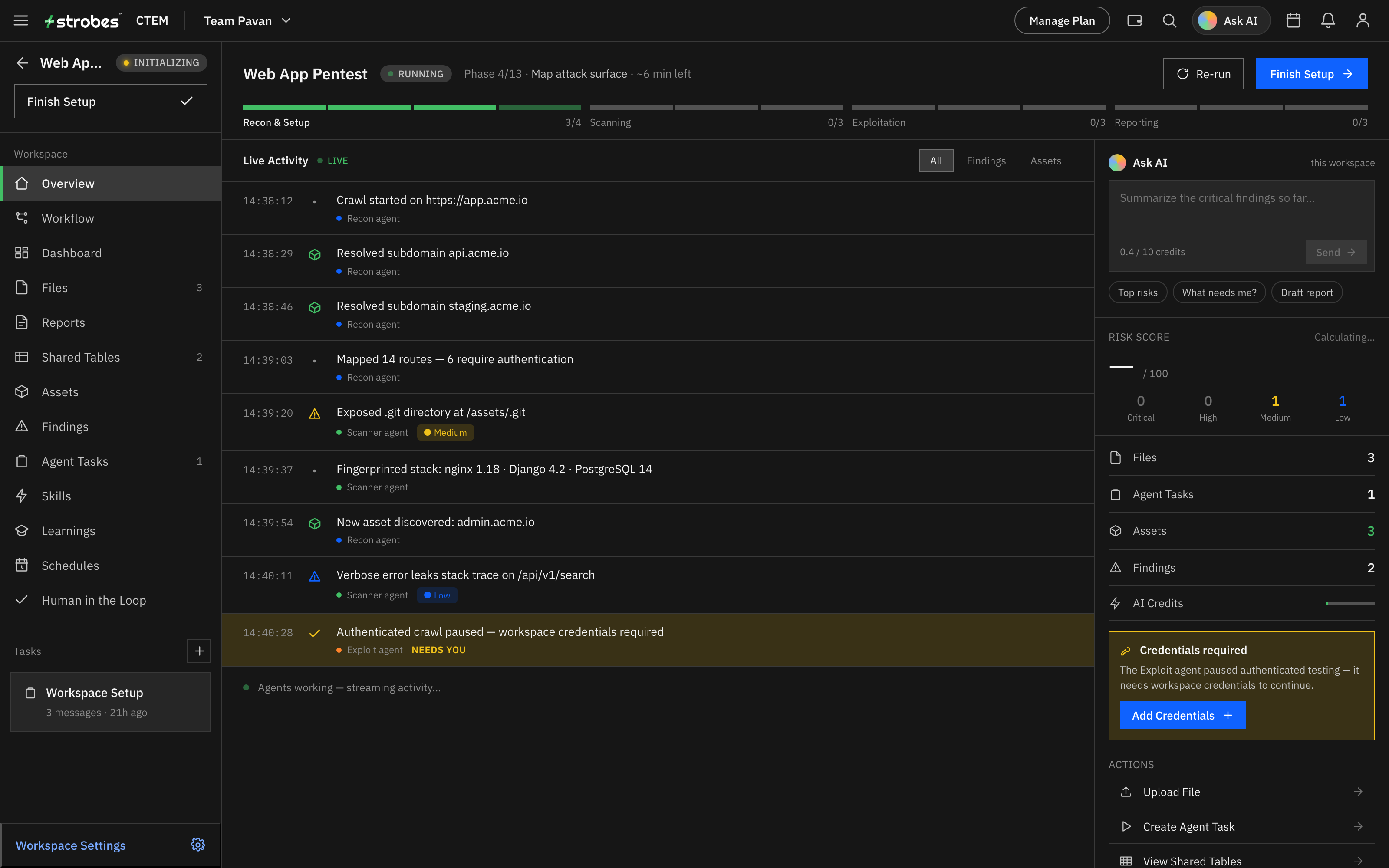
Human in the loop
Pause for review on sensitive actions, request approvals for higher-impact exploits, and hand off to your team mid-engagement, without slowing the agents down.
Private data and BYOM
Bring your own model and keys. Data, prompts, and findings stay inside your tenant. SOC 2-ready isolation, no training on your data, and nothing shared across customers.
Persistent agent memory
Findings, recon, and exploit context carry across phases, runs, and assets. Each engagement builds on the last, so the platform gets sharper about your environment over time.
Continuous re-verification
Every patch triggers an exploit replay, clean confirmation that the fix actually worked, not just that the ticket closed, with new weaknesses surfaced as the environment changes.
Bring your own scope, your own model, and your compliance constraints. Watch an agentic engagement run end to end, with you in the loop.
Built for enterprise-grade security
Isolated sandbox per engagement
Every run executes in a fresh, ephemeral sandbox. Payloads, credentials, and target data never leak across customers or runs.
Runs on internal networks
Deploy a lightweight on-prem agent and run agentic pentests inside VPCs, Kubernetes clusters, and Active Directory domains. No data leaves your perimeter.
Human in the loop
Pause for review on sensitive actions, request approvals for higher-impact exploits, and hand off to your team mid-engagement — without slowing the agents down.
RCE on auth-service — exploit chain ready
Private data and BYOM
Bring your own model and keys. Data, prompts, and findings stay within your tenant. SOC 2-ready isolation, no training on your data.
Persistent agent memory
Findings, recon, and exploit context persist across phases, runs, and assets. The platform gets smarter about your environment with every engagement.
Continuous re-verification
Every patch triggers an exploit replay — clean confirmation that the fix actually worked, not just that the ticket closed.
What do security teams say about Strobes?
Independent reviews back the picture this comparison paints. Strobes holds a 4.6 on G2 and 4.6 on Gartner Peer Insights, and 95% of reviewers would recommend it to a colleague. A few that speak to the capabilities this comparison is about:
“The AI agents do in minutes what used to take our team hours. Auto-triage, validation of exploitability, and even suggested remediation code. It is like having an extra senior security engineer on the team.”
“The pentesting-as-a-service offering is exceptional. The team is thorough, responsive, and the platform makes collaboration during engagements smooth. Results are actionable, not just a dump of CVEs.”
“It doesn’t just dump vulnerability data. It prioritizes what actually matters based on risk and exploitability. The correlation between SAST, DAST, and dependency issues into a single, actionable view saves real time.”
“Before Strobes, we were drowning in scanner outputs from 8 different tools. Now everything is correlated, deduplicated, and prioritized. Our MTTR dropped from 45 days to 18 days in the first quarter.”
Reviews are from G2 and Gartner Peer Insights, where the full set is public.
How should you evaluate the two against your environment?
Don’t take any vendor’s framing, including this one. Run both against an environment that matters to you and watch four things.
First, test the network. Point both at a representative internal segment and compare how they discover, chain, and prove attack paths to domain compromise; NodeZero is strong here and Strobes should hold its own. Second, test the application layer. Point both at a real authenticated web app and API and compare depth, and confirm whether web app testing is generally available or still Early Access. Third, check extensibility. If you need to author your own methodology, run custom sub-agents, or bring your own model, confirm each platform supports it. Fourth, weigh deployment. Decide whether a no-agent host or a customizable multi-tenant harness fits your environment better.
Frequently asked questions
NodeZero is an autonomous, no-agent pentester that covers internal and external network, AD, and cloud. Strobes runs an agentic harness across the same surfaces and adds a dedicated 21-phase web app agent, REST and GraphQL API testing, open SKILL.md sub-agents you can author yourself, and a bring-your-own-LLM model. NodeZero runs a fixed autonomous engine with no code to write.
Yes. Both platforms autonomously test internal and external networks, Active Directory, and cloud, crack credentials, and chain attack paths to domain compromise with proof. NodeZero has a longer track record in network pentesting. Strobes runs the same surfaces through an agentic harness and adds more developed application-layer testing.
NodeZero WebApp Pentest is in Early Access as of 2026, covering OWASP Top 10 and access-control flaws that chain into identity and infrastructure. Its generally available focus is internal and external network, AD, and cloud pentesting. Strobes has a production web app agent (21-phase, OWASP WSTG) plus REST and GraphQL API testing available now.
NodeZero is purpose-built for autonomous, no-agent internal and assumed-breach network testing, and it handles that well. Strobes covers internal network and AD testing through its Network agent as part of a broader multi-surface engagement. If internal, assumed-breach network testing is your only priority, NodeZero is a reasonable fit.
Neither publishes list pricing. NodeZero is an annual subscription with unlimited pentests, often sold through MSSP and channel partners. Strobes uses a credit-based platform model with retests bundled into the lifecycle. Which is more economical depends on your scope and testing frequency, so the honest step is to get scoped quotes from both.
Choose NodeZero if autonomous, no-agent internal network testing at scale is your priority and you want a hands-off, scheduled engine. Choose Strobes if you also need mature web and API pentesting now, want to customize the engagement with your own methodology and model, or need multi-tenant deployment. Many teams can be well served by either, so the right answer depends on your priorities.
See an agent-run engagement on your stack
Bring your scope: surfaces, auth complexity, internal reach, multi-tenancy, compliance. We’ll show you exactly how Strobes runs against your environment and where it fits alongside or in place of what you have.
- Horizon3.ai product and platform documentation, horizon3.ai and docs.horizon3.ai, as of July 2026, for NodeZero autonomous pentesting, internal and external network, AD, cloud, and Kubernetes coverage, no-agent deployment, and the WebApp Pentest Early Access program.
- Horizon3.ai press materials, 2026, for NodeZero test volume, customer count, and partner and MSSP model.
- Third-party reviews and comparisons (G2, Gartner Peer Insights, firecompass.com) for NodeZero’s assumed-breach internal focus and the maturity of its external web and API testing.
- Strobes product documentation and customer reviews, strobes.co, for the agentic harness architecture, application-layer agents, extensibility, and remediation lifecycle.
Disclosure: This comparison is written by Strobes. Every Horizon3 capability cited comes from Horizon3’s own documentation or independent third-party reviews, listed above, so you can check them yourself.
Product details reflect each vendor’s public documentation as of July 2026 and may change. Horizon3.ai and NodeZero are trademarks of their respective owner.