
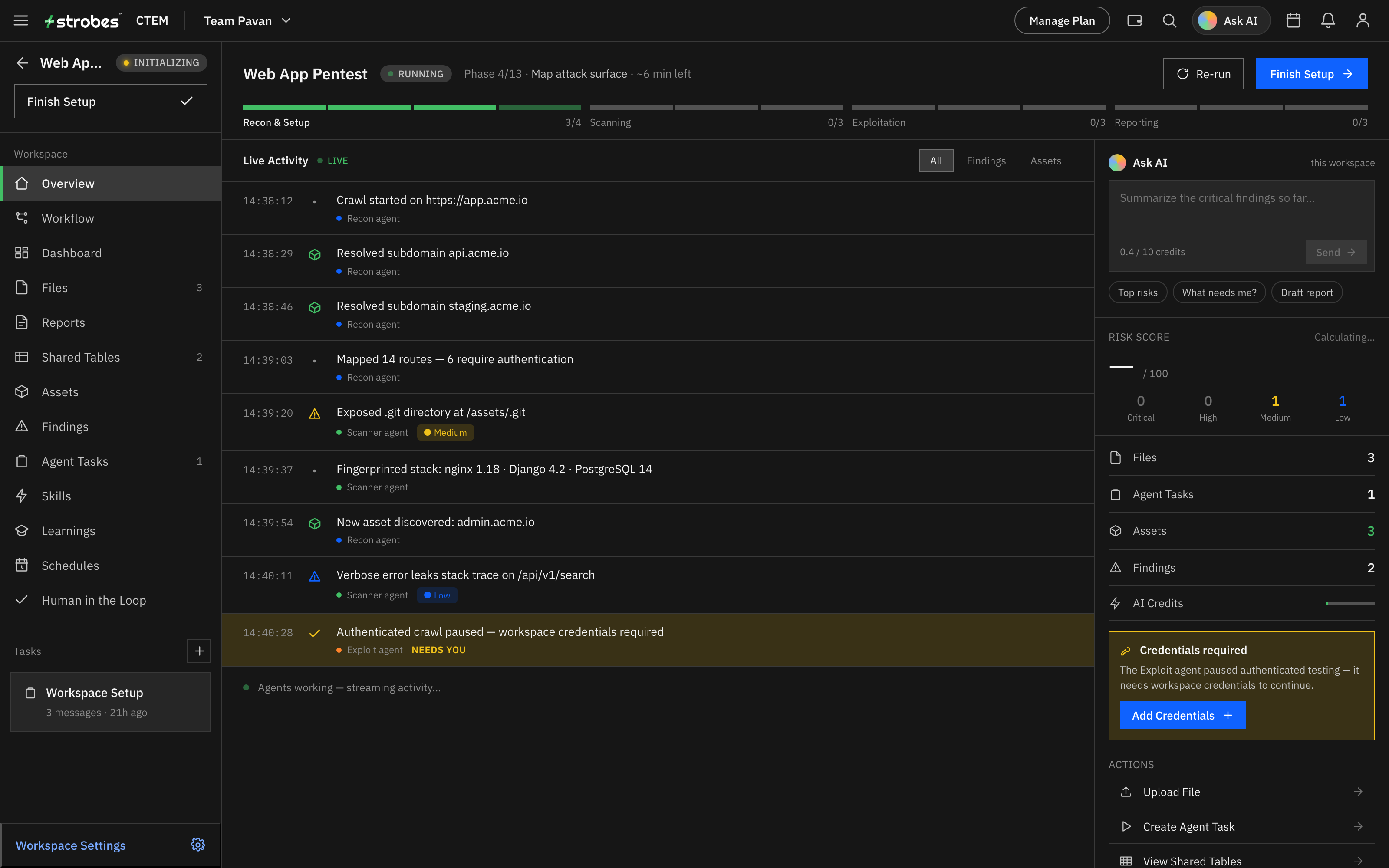
Escape’s AI Pentesting product, Cascade, is a real agentic pentester: multiple specialist agents that reason over an application, chain multi-step attacks, and hand back a working proof of exploit rather than a raw finding. It is genuinely good at that. The question when you compare it to Strobes is not whether it chains exploits, both do, but how far the target reaches. Cascade tests applications and APIs. The internal network behind them, Active Directory, and the cloud infrastructure they run on are outside what its pentest targets.
For teams whose attack surface is applications and APIs, that scope is a good match. For teams that need a pentest across every surface an attacker crosses, the strongest Escape alternative in 2026 is Strobes, an agentic pentesting platform that tests web, API, network, Active Directory, and cloud, and chains findings across all of them into a proven attack path. This post compares the two AI pentesting products directly and is honest about where Escape is the better fit.
- Escape’s AI Pentesting (Cascade) is a multi-agent pentester for applications and APIs: it chains multi-step attacks, tests as multiple users, and returns a working proof of exploit.
- Cascade’s pentest targets are application and API URLs. It does not test internal networks, Active Directory, or cloud infrastructure as part of the pentest, and it has no shell or lateral movement.
- Strobes is the strongest Escape alternative for teams that need a pentest across the full attack surface: web, API, network, Active Directory, and cloud, with chaining across all of them.
- Both are agentic, prove exploitability, do authenticated testing, and run in CI/CD. Strobes adds a sandboxed shell, lateral movement, and a full remediation lifecycle with prioritization and retests.
- Choose Escape if your pentest scope is applications and APIs. Choose Strobes if an attacker could move past the app into your network, identity, or cloud.
- 01Why are teams looking for an Escape alternative?
- 02What is the best alternative to Escape in 2026?
- 03How does Strobes compare to Escape?
- 04When is Escape the better call?
- 05What does Strobes test that Escape does not?
- 06What is better than Escape?
- 07What do security teams say about Strobes?
- 08How should you evaluate the two?
- 09FAQ
Why are teams looking for an Escape alternative?
The reason is almost always scope, not capability. Cascade is a competent agentic pentester; teams look elsewhere when what they need to test grows past the application. An AI pentester scoped to app and API URLs can chain a sophisticated attack inside that application and prove it. What it cannot do is tell you what happens after: the pivot into the internal network, the domain controller reached through a foothold, the over-permissioned cloud role. For anyone who has to answer “and then how far does it go,” the application is the start of the attack path, not the whole of it.
The gaps that send teams looking, based on Escape’s own AI Pentesting documentation, are structural. Cascade’s pentest scope is defined by target URLs (frontend, API, admin hosts). It does not run internal network pentesting, Active Directory attacks, or cloud infrastructure exploitation as part of the pentest, and it has no interactive shell for lateral movement. Strobes covers the application layer and those surfaces beyond it, which is what the rest of this comparison walks through.
What is the best alternative to Escape in 2026?
Escape’s pentest scope is applications and APIs, so the tools worth weighing against it are the other application-layer autonomous and agentic pentesters, plus one platform that carries the same testing across every surface:
- Strobes is an agentic pentesting platform that spans web, API, network, Active Directory, and cloud, and chains findings into a proven attack path rather than reporting them in isolation.
- Aikido is an autonomous web app and API pentester built for developer teams, with fast self-serve scans and fixes delivered as pull requests.
- XBOW is an autonomous pentesting engine known for web application exploit-chaining and topping bug-bounty leaderboards.
Aikido and XBOW stay on the application tier, like Escape. For teams whose pentest scope is applications and APIs, any of these can fit. For teams that need one platform to pentest the full attack surface an attacker would actually cross, Strobes is the stronger fit, and the rest of this comparison focuses there.
The distinction is scope, not sophistication. Both Strobes and Escape run coordinated agents that chain exploits and prove them. Escape scopes its pentest to the application and its APIs. Strobes runs the same kind of agentic engagement but extends it across web, API, network, Active Directory, cloud, code review, and threat intelligence, with shared workspace state so a weakness on one surface becomes the way into the next.
Chain the app, prove the exploit
A coordinator runs specialist agents over an application: graph reasoning to map it, attack agents to chain multi-step exploits, and a proof-of-exploit step that returns the working request chain. Scope is defined by target URLs, so testing stays within the application and its APIs.
Chain across every surface
A supervisor coordinates specialist agents for web, API, network, AD, cloud, code review, and threat intel, each with its own prompt, tool allowlist, and context window. State flows through shared workspace tables, so a finding on the app becomes the entry point into the network or cloud behind it.
How does Strobes compare to Escape?
Start with the at-a-glance view, then the detailed capability matrix below it. Escape claims are drawn from escape.tech and third-party reviews; where a capability is not documented, that is noted.
| Category | Strobes | Escape |
|---|---|---|
| Primary use case | Agentic pentest across web, API, network, AD, cloud, plus CTEM lifecycle | Agentic pentest (Cascade) for applications and APIs |
| Pentest surfaces | Web, REST, GraphQL, network, AD, internal/shell, code review, cloud, threat intel | Web apps, REST, GraphQL, SPAs. No network, AD, or infrastructure in the pentest |
| Agentic model | Supervisor + specialist agents across surfaces | Multi-agent (Cascade) scoped to the application |
| Exploitation | Chains findings across surfaces to impact | Chains multi-step attacks within the application, with proof of exploit |
| Lateral movement | Sandboxed shell, network reach, domain attacks | Not in scope |
| Auth handling | Live-browser handoff for SSO, MFA, CAPTCHA | OAuth, SAML, MFA, CAPTCHA, agentic browser |
| Enterprise / MSSP | Multi-tenant, per-client isolation, BYO LLM, on-prem and VPC | Private tenant, RBAC, cloud and on-prem hybrid |
| Remediation | Two-way Jira, GitHub, Azure Boards, EPSS + KEV, bundled retests | Proof of exploit, framework-specific fixes, regression tests, Jira |
| Best for | Full-surface pentests and CTEM programs | Continuous application and API pentesting in the SDLC |
Capability matrix
Row by row, both run coordinated agents that chain and prove exploits. The difference is how far the pentest reaches.
| Capability | Strobes | Escape |
|---|---|---|
| Web application (OWASP WSTG) | ✓ 21-phase dedicated agent | ✓ Agentic web app pentest |
| API — REST | ✓ Dedicated API agent | ✓ Core strength, schema-driven |
| API — GraphQL | ✓ Schema-aware | ✓ Native GraphQL support |
| Business-logic / BOLA / IDOR | ✓ Multi-session access-control tests | ✓ Business-logic engine |
| Multi-agent, coordinated | ✓ Supervisor + specialists | ✓ Cascade multi-agent |
| Multi-step chaining (in-app) | ✓ Yes | ✓ Yes, with proof of exploit |
| Proof of exploit | ✓ Validated attack chain | ✓ Working request chain |
| Network / port scanning (pentest) | ✓ nmap, masscan, multi-host | ✕ Not in pentest scope |
| Active Directory attacks | ✓ AD auditing in Network agent | ✕ Not covered |
| Internal network / shell (pivot) | ✓ Sandboxed shell + SSH | ✕ No lateral movement |
| Cloud — AWS (IAM, S3, EC2) | ✓ Dedicated cloud agent | ✕ App layer only |
| Cross-surface exploit chaining | ✓ Chains app to network to cloud | ✕ In-app chains only |
| Attack surface discovery (ASM) | ✓ Discovery + threat intel agent | ✓ API and app ASM |
| Authenticated testing (OAuth, MFA) | ✓ Live-browser handoff | ✓ OAuth, SAML, MFA, CAPTCHA |
| Custom sub-agents / skills | ✓ Open SKILL.md sub-agents | Custom rules, fixed agent set |
| CI/CD integration | ✓ Event-triggered execution | ✓ Security gates on every push |
| Full VM / remediation lifecycle | ✓ Two-way sync, EPSS + KEV, retests | Fixes, regression tests, Jira |
| On-prem / private deployment | ✓ On-prem, VPC, multi-tenant | ✓ Cloud and on-prem hybrid |
| Pentest surface coverage | Full attack surface | Application and API |
Escape earns its checks as a capable agentic pentester for applications and APIs. Its pentest simply stops at the application. Strobes runs the same style of agentic engagement and carries it into the network, identity, and cloud behind the app.
When is Escape the better call?
Escape is the better call for a specific scope. If your pentest targets are applications and APIs, and you want a continuous agentic pentest wired into the SDLC, Cascade does that job well and is a simpler choice than standing up a full-surface platform.
- Your scope is APIs and web applications, especially GraphQL-heavy or API-first architectures.
- Business-logic flaws, BOLA, IDOR, and access-control testing are your top priority.
- You want a continuous pentest running in CI/CD on every push, with proof of exploit and fixes developers can act on.
- You do not need internal network, Active Directory, or cloud infrastructure tested by the same tool.
Many teams run Escape for API coverage and add a broader platform for everything else.
What does Strobes test that Escape does not?
The gap is everything below and around the application. Cascade will chain an attack through the app and prove it. What it does not do is take that foothold further: pivot into the network behind the app, move laterally, harvest credentials from Active Directory, and reach the cloud account. Strobes does. That is the difference between pentesting the front door and pentesting the whole building.
No internal network pentest, no Active Directory attacks, no lateral movement, no interactive shell into a host. Testing stays within the application footprint.
Network agent scope: shell execution via workspace SSH, nmap, service enumeration, multi-host testing, and AD auditing. An operator can drop into an internal network, run domain enumeration, attempt Kerberoasting, capture NTLM hashes, and walk the attack graph toward domain admin.
What is better than Escape?
For pentest scope wider than applications and APIs, Strobes is the more complete platform. Cascade runs a strong agentic pentest of the application. Strobes runs the same style of engagement across the whole attack surface, from first recon through validated remediation. Here is the head-to-head, stated plainly.
- Strobes pentests 11 surfaces including internal network, Active Directory, and cloud. Escape pentests applications and APIs, and does not cover network or infrastructure.
- Strobes chains weaknesses across surfaces into one attack path. Escape chains multi-step attacks within the application and proves them, but does not pivot past it.
- Strobes runs a sandboxed shell with real network reach for lateral movement and domain attacks. Escape has no shell and no lateral movement.
- Both are multi-agent, both prove exploitability with a working chain, and both do authenticated testing through SSO, MFA, and CAPTCHA.
- Strobes lets MSSPs and consultancies author and version their own methodology through open SKILL.md sub-agents. Escape runs a fixed set of agents with custom rules.
- Strobes flows findings into a full CTEM lifecycle with two-way Jira and GitHub sync, EPSS and CISA KEV prioritization, and bundled retests. Escape provides proof of exploit, fixes, and regression tests scoped to the app.
- Both integrate with CI/CD and offer on-prem or hybrid deployment.
Escape remains a strong choice for continuous application and API pentesting. But for security teams that need to pentest the full attack surface an attacker would cross, or that are building toward a full CTEM program, Strobes runs the same agentic approach across every surface and closes the loop to remediation.
Why Strobes · One surface, or all of them
Strobes runs the same agentic engagement across every surface
Escape scopes its pentest to applications and APIs. These are the capabilities Strobes adds so a weakness on one surface becomes the way into the next, rather than the end of the test.
Beyond the application layer
The same coordinated agents that test web and APIs also cover internal and external network, Active Directory, and cloud, in one engagement.
Shared workspace state
An agent on day three has full context from day one: every crawled endpoint, tested parameter, and credential tried, so surfaces inform each other.
Real shell and lateral movement
Strobes runs a sandboxed shell with real network reach, so an app foothold can pivot to lateral movement and domain attacks, which app-only tools cannot do.
Author your own methodology
Agents follow the open SKILL.md standard, so an MSSP or consultancy can version its own testing methodology and add sub-agents, with bring-your-own-LLM.
Bring your app, its APIs, and the infrastructure behind them. Watch Strobes pivot from one to the next in a single run.
Built for enterprise-grade security
Isolated sandbox per engagement
Every run executes in a fresh, ephemeral sandbox. Payloads, credentials, and target data never leak across customers or runs.
Runs on internal networks
Deploy a lightweight on-prem agent and run agentic pentests inside VPCs, Kubernetes clusters, and Active Directory domains. No data leaves your perimeter.
Human in the loop
Pause for review on sensitive actions, request approvals for higher-impact exploits, and hand off to your team mid-engagement — without slowing the agents down.
RCE on auth-service — exploit chain ready
Private data and BYOM
Bring your own model and keys. Data, prompts, and findings stay within your tenant. SOC 2-ready isolation, no training on your data.
Persistent agent memory
Findings, recon, and exploit context persist across phases, runs, and assets. The platform gets smarter about your environment with every engagement.
Continuous re-verification
Every patch triggers an exploit replay — clean confirmation that the fix actually worked, not just that the ticket closed.
What do security teams say about Strobes?
Independent reviews back the picture this comparison paints. Strobes holds a 4.6 on G2 and 4.6 on Gartner Peer Insights, and 95% of reviewers would recommend it to a colleague. A few that speak to the capabilities this comparison is about:
“The AI agents do in minutes what used to take our team hours. Auto-triage, validation of exploitability, and even suggested remediation code. It is like having an extra senior security engineer on the team.”
“The pentesting-as-a-service offering is exceptional. The team is thorough, responsive, and the platform makes collaboration during engagements smooth. Results are actionable, not just a dump of CVEs.”
“It doesn’t just dump vulnerability data. It prioritizes what actually matters based on risk and exploitability. The correlation between SAST, DAST, and dependency issues into a single, actionable view saves real time.”
“Before Strobes, we were drowning in scanner outputs from 8 different tools. Now everything is correlated, deduplicated, and prioritized. Our MTTR dropped from 45 days to 18 days in the first quarter.”
Reviews are from G2 and Gartner Peer Insights, where the full set is public.
How should you evaluate the two against your environment?
Four questions settle it quickly:
- What is your attack surface? If it is APIs and web apps only, Escape’s depth may be all you need. If it includes a network, identity provider, or cloud, you need broader coverage.
- Is your pentest scope only applications and APIs? If so, Cascade covers that well. If it includes network, identity, or cloud, you need a pentest that reaches them.
- Do you need to prove blast radius? If you need to show how an app flaw becomes a network or cloud compromise, you need cross-surface chaining, which is Strobes.
- Where do findings go? If you want a full remediation lifecycle with prioritization and retests across all assets, Strobes fits. If you want app-layer fix snippets in CI/CD, Escape fits.
FAQ
No. Escape is purpose-built for APIs and web applications, with strong GraphQL, BOLA, and business-logic coverage. It does not test internal networks, Active Directory, or infrastructure. Escape’s own comparison content points to other tools for internal and infrastructure testing.
For most teams, yes. Strobes runs an agentic pentest of web apps and APIs and adds internal network, Active Directory, cloud, and a full remediation lifecycle. Escape stays focused on application and API pentesting, so some API-first teams run both. Escape findings can also be imported into Strobes for lifecycle management, so moving over isn’t all-or-nothing.
Both run agentic API pentests with proof of exploit. Escape is focused on applications and APIs, with strong GraphQL and business-logic coverage. Strobes pentests REST and GraphQL APIs as part of a broader engagement that also reaches network, AD, and cloud. If your scope is only applications and APIs, Escape does it well. If you need the full attack surface, Strobes fits better.
Neither publishes list pricing. Escape is sales-quoted based on the number of applications and testing depth, with a free tier for a single API. Strobes uses a credit-based platform model with retests bundled into the lifecycle. Which is cheaper depends on your scope: API-only versus full multi-surface coverage.
Yes. Strobes clears SSO, MFA, and CAPTCHA with a live-browser handoff and continues testing authenticated. Escape also supports authenticated testing across OAuth, SAML, JWT, and TOTP MFA for its API and app scans.
See a full-surface engagement on your stack
Bring your app, its APIs, and the infrastructure behind them. We’ll show you exactly how Strobes pivots from one surface to the next in a single run, and where it fits alongside or in place of what you have.
- Escape AI Pentesting product and documentation, escape.tech/product/ai-pentesting and docs.escape.tech/documentation/ai-pentesting, as of July 2026, for Cascade multi-agent architecture, graph reasoning, proof of exploit, pentest scope, authentication, and deployment.
- Third-party reviews (appsecsanta.com, AWS Marketplace, G2) for Escape’s API focus, pricing model, and capability boundaries.
- Escape blog comparison content (best AI pentesting tools, top automated pentesting tools) for its own positioning relative to infrastructure and exploit-chaining tools.
- Strobes product documentation and customer reviews, strobes.co, for surface coverage, agent architecture, and remediation lifecycle.
Disclosure: This comparison is written by Strobes. Every Escape capability and limitation cited comes from Escape’s own documentation or independent third-party reviews, listed above, so you can check them yourself.
Product details reflect each vendor’s public documentation as of July 2026 and may change. Escape is a trademark of its respective owner.