

How to Pentest APIs at Scale (Without Hiring 10 More Pentesters)
- ✓Most organizations run 200-500+ APIs in production but pentest fewer than 10% of them annually. The rest go untested because manual pentesting doesn't scale to API volume.
- ✓API-specific vulnerabilities (broken object-level authorization, mass assignment, SSRF via internal endpoints) require testing every single endpoint with valid auth context, not just running a DAST scanner against the root URL.
- ✓AI-powered pentesting agents can crawl API documentation (OpenAPI/Swagger specs, GraphQL introspection, Postman collections), generate context-aware test cases, and run them across hundreds of endpoints in hours, not weeks.
- ✓Combining AI pentesting for breadth with human testers for complex business logic flaws gives you coverage that neither approach achieves alone.
- ✓Strobes AI agents handle API reconnaissance, authentication chaining, and OWASP API Security Top 10 testing at machine speed, with Supervisor Mode giving you full control over what runs against production.
Why Can't Traditional Pentesting Keep Up with API Growth?
The average mid-market SaaS company runs between 200 and 500 distinct API endpoints. Enterprise organizations easily exceed 2,000. Every new microservice, every mobile app integration, every third-party webhook: they all add API surface area. And that surface area grows faster than any security team can manually test it.
Here's the math that breaks most pentesting programs. A skilled API pentester can thoroughly test 15-25 endpoints per day, depending on complexity. That includes authentication setup, parameter fuzzing, authorization checks across roles, and documenting findings. A typical engagement scopes 40-60 endpoints and takes 1-2 weeks. If you've got 500 endpoints, you're looking at roughly 20-25 pentester-weeks of effort for a single pass. At $150-250/hour for contract pentesters, that's somewhere between $120,000 and $250,000 per full sweep.
Most companies respond to this by doing what any resource-constrained team would do: they prioritize. They pentest the payment API, the authentication service, maybe the admin dashboard endpoints. The other 400+ endpoints? They get a vulnerability scan at best. Usually nothing.
That's not a testing strategy. That's a coverage gap with a justification attached.
The Verizon 2024 DBIR showed that web application attacks (predominantly API-based) accounted for a growing share of breaches. And the OWASP API Security Top 10 exists specifically because APIs have a distinct vulnerability profile that traditional web app testing misses. Broken Object-Level Authorization (BOLA) alone was behind multiple high-profile data exposures in the past two years.
The problem isn't that teams don't know APIs need testing. It's that manual testing at API scale costs more than most security budgets can absorb. Something in the model has to change.
What Makes API Pentesting Different from Web Application Testing?
API pentesting requires a fundamentally different approach than testing a rendered web application. When you pentest a web app, you're interacting with a browser: clicking buttons, filling forms, following redirects. The attack surface is visible. With APIs, there's no UI layer. The attack surface lives in endpoint paths, HTTP methods, request headers, JSON payloads, query parameters, and authentication tokens.
Three things make API testing particularly difficult to do manually at scale.
Authorization testing is endpoint-by-endpoint. BOLA, the #1 risk on the OWASP API Security Top 10, means testing whether User A can access User B's resources on every single endpoint that returns user-scoped data. That's not a check you run once. It's a check you run per endpoint, per role, per HTTP method. A 200-endpoint API with 4 roles means 800+ authorization test cases for BOLA alone.
API schemas drift constantly. Unlike a web app where the UI changes are visible, API changes can be invisible to consumers. A new query parameter, a changed response schema, a deprecated endpoint that's still active: these create testing gaps. If your pentest scope was defined six months ago against an OpenAPI spec that's since changed, you're testing a ghost.
Authentication chains are complex. Modern APIs use OAuth 2.0 flows, JWTs with refresh tokens, API keys with rate limiting, mutual TLS, and sometimes all of the above in different combinations across services. Setting up valid authentication context for each service is often the most time-consuming part of an API pentest engagement. A manual tester might spend the first 2-3 days of a week-long engagement just getting auth working correctly across all target services.
Traditional web application pentesting tools like Burp Suite and OWASP ZAP work well for individual API endpoints. They're excellent for proxy-based testing when you can intercept and modify requests. But they require a human operator who understands the API's business logic, knows which parameters to fuzz, and can chain multi-step attacks. That human bottleneck is exactly what prevents API testing from scaling.
What Does the OWASP API Security Top 10 Actually Look Like in Practice?
The OWASP API Security Top 10 isn't just a ranking; it's a testing checklist. Each item maps to specific test cases that need to run against every relevant endpoint. Here's what the top risks look like in real API engagements.
API1:2023, Broken Object-Level Authorization (BOLA). You request GET /api/v1/orders/12345 with User A's token and get User A's order. Then you change the ID to 12346 (User B's order) and send the same request. If you get User B's data, that's BOLA. Simple to test on one endpoint. Now multiply by every endpoint that uses an object reference in the URL path, query parameter, or request body.
API2:2023, Broken Authentication. Weak JWT validation (accepting alg: none), tokens that don't expire, password reset flows that leak tokens in URLs, rate limiting that doesn't apply to auth endpoints. Each of these requires targeted testing against the authentication service.
API3:2023, Broken Object Property Level Authorization. An endpoint returns a user object with name, email, role, and internal_notes. A regular user shouldn't see internal_notes or be able to modify role via a PUT request. Testing this means comparing response objects across privilege levels and attempting mass assignment on every writable endpoint.
API5:2023, Broken Function Level Authorization. Admin endpoints exposed without proper role checks. DELETE /api/v1/users/{id} returns 403 for regular users but what about POST /api/v1/admin/export-users? These are often discovered through endpoint enumeration and brute-forcing paths that aren't in the public documentation.
Every one of these risks requires testing across every applicable endpoint. Manually, that's weeks of work. Automated scanners catch some (particularly injection flaws and misconfigurations), but BOLA and authorization flaws require contextual understanding of the application's data model. That's where AI pentesting fills the gap: it can understand API schemas, generate test cases per endpoint, chain authentication flows, and test authorization boundaries at machine speed.
How Do You Pentest Hundreds of API Endpoints Without a Massive Team?
You combine three layers: automated scanning for known vulnerability patterns, AI-driven testing for context-aware security checks, and human expertise for complex business logic.
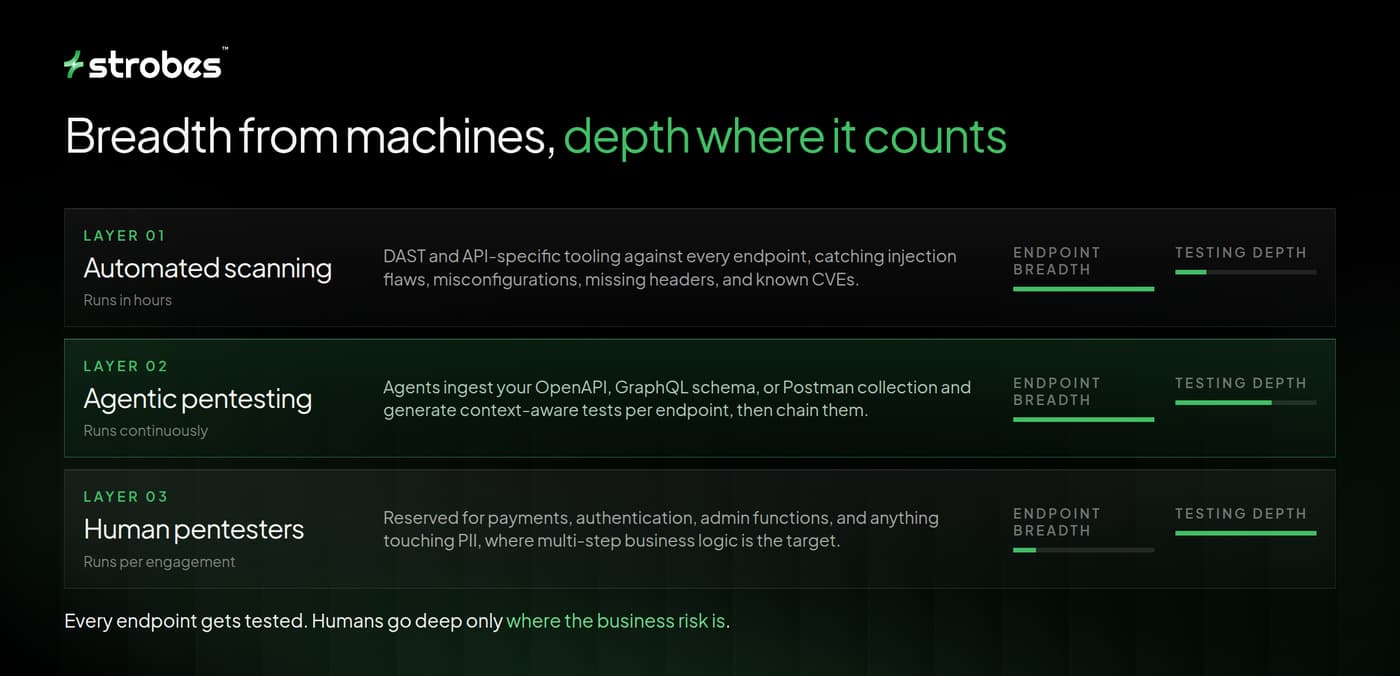
Layer 1: Automated scanning. Run Nuclei templates, DAST scanners, and API-specific tools against every endpoint to catch the basics (injection flaws, misconfigurations, missing security headers, known CVEs in API frameworks). This catches maybe 20-30% of what a full pentest would find, but it runs against 100% of your endpoints in hours.
Layer 2: AI-driven pentesting. This is where the economics change. An AI pentesting agent ingests your API documentation (OpenAPI specs, GraphQL schemas, Postman collections, or even just a list of endpoints with sample requests) and generates context-aware test cases. It understands that GET /api/v1/users/{id} needs BOLA testing, that PUT /api/v1/profile needs mass assignment checks, and that the auth endpoint needs brute-force and token manipulation tests.
The AI agent doesn't just run a fixed playbook. It adapts based on responses. If an endpoint returns a 403, it tries different auth tokens, different HTTP methods, different content types. If it finds BOLA on one endpoint, it automatically tests the same pattern across all similar endpoints. If it discovers undocumented endpoints during reconnaissance, it adds them to scope.
Layer 3: Human pentesters for high-value targets. Reserve your manual pentesting budget for the APIs that handle the most sensitive operations: payment processing, authentication, admin functions, and any endpoint that touches PII. Human testers excel at multi-step business logic attacks that require understanding what the API is supposed to do, not just what it does.
This layered model means your 500 endpoints get tested, all of them. Scanners and AI agents handle breadth. Humans handle depth on the 20-30 endpoints that matter most. Total cost drops by 60-70% compared to full manual testing, while actual coverage increases because you're no longer ignoring 90% of your API surface.
What Should an AI API Pentesting Workflow Look Like?
A well-designed AI pentesting workflow for APIs follows five phases. Here's what each looks like and what the agent actually does.
Phase 1: API Discovery and Documentation Ingestion. The agent starts by consuming everything you give it (OpenAPI/Swagger specs, GraphQL introspection results, Postman collections, HAR files from browser traffic, or raw endpoint lists). If you provide nothing, it performs active discovery: crawling, brute-forcing common API paths (/api/v1/, /graphql, /rest/), checking for exposed documentation endpoints (/swagger.json, /docs, /.well-known/), and analyzing JavaScript bundles for hardcoded API paths.
Output: a complete endpoint inventory with HTTP methods, parameter types, authentication requirements, and data models.
Phase 2: Authentication Setup and Chaining. The agent configures authentication for each target service. It handles OAuth 2.0 client credentials, authorization code flows, JWT refresh cycles, API key rotation, and multi-factor auth where credentials are provided. For multi-service architectures, it manages separate auth contexts per service and handles token propagation between dependent APIs.
This phase is where AI agents save the most manual effort. Auth setup that takes a human tester 2-3 days happens in minutes.
Phase 3: Systematic Vulnerability Testing. Working through each endpoint systematically, the agent runs OWASP API Security Top 10 test cases: BOLA checks across object IDs, mass assignment attempts on writable fields, injection payloads in every parameter, authentication bypass techniques, rate limit testing, and SSRF probes on URL-type parameters. It uses valid auth context, so it's testing authorization, not just authentication.
Phase 4: Chained Attack Scenarios. The agent attempts multi-step attacks: escalating from a low-privilege user to admin through chained vulnerabilities, combining BOLA with mass assignment to modify another user's role, using SSRF to reach internal services that aren't directly exposed. This is where AI agents have improved significantly. They can now reason about attack chains, not just test individual endpoints in isolation.
Phase 5: Reporting with Evidence. Every finding includes the full HTTP request/response pair, reproduction steps, CVSS scoring, and remediation guidance. The report maps findings to OWASP API Security Top 10 categories and compliance requirements (PCI DSS, SOC 2, ISO 27001).
Where Do Human Pentesters Still Beat AI on APIs?
AI pentesting isn't a replacement for human expertise, it's a multiplier. There are specific areas where experienced pentesters consistently outperform current AI agents.
Business logic flaws. An API for a banking app might let you transfer $0.001 to yourself 10,000 times, bypassing a minimum-transfer validation that only checks the total of individual transactions. An AI agent doesn't understand the business intent behind transaction limits unless you explicitly encode it. A human tester does.
Race conditions. Exploiting TOCTOU (time-of-check-time-of-use) bugs in APIs requires precise timing and creative thinking about concurrent requests. "What if I send 50 simultaneous requests to redeem a one-time coupon?" isn't a test most AI agents generate on their own yet.
Social engineering via API. Crafting phishing payloads that get stored and rendered through an API (stored XSS via API input), or manipulating webhook URLs to exfiltrate data to attacker-controlled servers: these require adversarial creativity that goes beyond systematic testing.
Novel attack chains across services. When a chain requires understanding how three different microservices interact with a message queue and a shared cache, and the vulnerability only manifests when a specific sequence of events occurs across services, that's still human territory.
The right model: AI agents test every endpoint against known vulnerability patterns at scale. Humans focus on the 10% of endpoints where business logic, race conditions, or cross-service interactions create risks that systematic testing misses. You're not choosing between AI and human pentesters. You're choosing how to allocate each where they deliver the most value.
How Does Strobes Handle API Pentesting at Scale?
Strobes AI agents are built to handle the specific challenges of API pentesting at scale. Here's what that looks like in practice.
The agent ingests your API documentation automatically. Point it at a Swagger URL, upload a Postman collection, or let it discover endpoints through active crawling. It builds a complete endpoint map, identifies authentication requirements per service, and generates a testing plan that covers the OWASP API Security Top 10 across every endpoint.
For authorization testing (the #1 gap in most API programs), the agent creates test accounts at different privilege levels and systematically tests BOLA and function-level authorization across the full endpoint inventory. A 300-endpoint API that would take a manual tester 3 weeks to test for authorization flaws gets tested in hours.
Supervisor Mode gives you control over what runs against your environment. Start in User mode for production APIs, where you approve each test before it executes. Switch to Auto for staging environments where you want the agent to run unattended. Auto-approval rules let you pre-approve low-risk tests (recon, GET-based BOLA checks) while requiring manual approval for anything destructive.
Scheduled pentests mean your APIs get tested on cadence: weekly, monthly, or after every major release. Each scheduled run diffs against the previous results, so you see exactly what's new, what's fixed, and what's still open. No more annual pentest cycles where you discover the same APIs have been vulnerable for 11 months.
The credit-based pricing model means you pay for what you test. A full API pentest on 200 endpoints with the Standard model tier costs a fraction of a single manual engagement, and it runs in hours, not weeks.

What's a Realistic API Pentesting Program for a Growing Company?
Here's a practical API pentesting program that balances coverage, cost, and thoroughness.
Tier 1: Continuous, all APIs, AI-driven. Every API endpoint in your inventory gets tested monthly by an AI agent. Full OWASP API Security Top 10 coverage, automated auth testing, and regression checks against previously found vulnerabilities. This is your coverage baseline. Cost: a fraction of a single manual engagement, repeated monthly.
Tier 2: Quarterly, high-value APIs, human testers. Your payment processing, authentication, admin, and PII-handling APIs get a manual pentest by experienced API security testers every quarter. They focus on business logic, race conditions, and cross-service attack chains that AI agents might miss. Cost: 2-3 focused engagements per year instead of trying to cover everything.
Tier 3: Event-driven, new APIs, AI-driven on merge. Every time a new API or major API change hits staging, an AI pentest runs automatically as part of the CI/CD pipeline. Developers get findings before code reaches production. This shift-left approach catches vulnerabilities when they're cheapest to fix.
This three-tier model gives you something that no amount of manual pentesting alone can achieve: continuous coverage across your entire API surface, with deep testing focused where it matters most. The total cost is typically 40-60% less than an all-manual approach while providing 3-5x the coverage.
The key shift in thinking is this: API pentesting isn't a project you do once a year. It's a continuous program that runs alongside API development. AI makes that economically viable for the first time.
Frequently Asked Questions
Can AI pentest GraphQL APIs as effectively as REST APIs?
Yes. AI agents handle GraphQL introspection, query complexity analysis, nested query depth attacks, and field-level authorization testing. GraphQL's self-documenting nature (introspection) actually makes it easier for AI agents to build complete test coverage, since they can discover the entire schema automatically.
Do I need to provide API documentation for AI pentesting to work?
It helps but isn't required. AI agents perform active discovery: crawling, path brute-forcing, analyzing JavaScript bundles, and checking for exposed documentation endpoints. Providing an OpenAPI spec or Postman collection speeds up the process and improves coverage, but the agent can work with a list of base URLs alone.
How do AI pentesting agents handle rate-limited APIs?
Agents respect rate limits by default to avoid disrupting production services. They detect rate limiting through 429 responses and adjust request timing accordingly. In Strobes, you can configure custom rate limits per target through Custom Instructions to match your production thresholds.
Is AI API pentesting sufficient for PCI DSS compliance?
AI pentesting can satisfy PCI DSS Requirement 11.3's penetration testing requirement, provided the methodology covers the required scope and findings are documented appropriately. Strobes generates compliance-mapped reports. For PCI DSS specifically, pair AI pentesting with focused manual testing on cardholder data endpoints to satisfy auditor expectations.
What's the difference between DAST scanning and AI pentesting for APIs?
DAST scanners run predefined checks against endpoints: injection patterns, header analysis, known vulnerability signatures. AI pentesting agents understand API context. They test authorization boundaries, chain multi-step attacks, adapt testing based on responses, and generate novel test cases based on the API's data model. DAST finds surface issues; AI pentesting finds logic-level flaws.
How long does an AI pentest take on a 500-endpoint API?
Typically 4-8 hours for a full run including OWASP API Top 10 coverage, authorization testing across roles, and evidence collection. Compare that to 4-6 weeks for a manual pentest of the same scope.
Sources
- OWASP API Security Top 10 (2023)
- Verizon 2024 Data Breach Investigations Report
- NIST SP 800-95: Guide to Secure Web Services
- PCI DSS v4.0: Requirement 11.3