
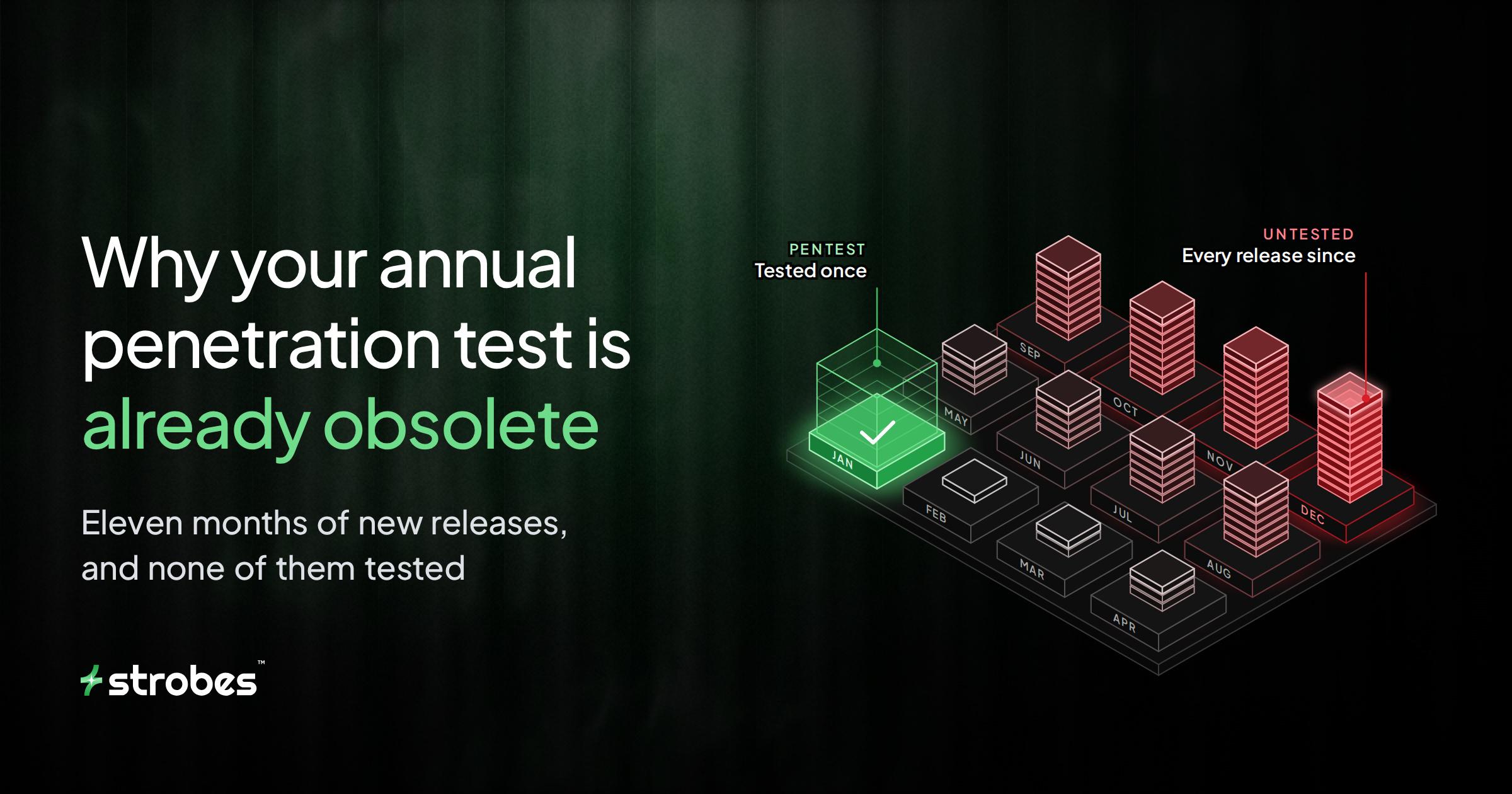
Why your annual penetration test is already obsolete
Your last pentest told you something useful about the systems it tested. That was accurate on the day it was written.
Now count the releases, new services, and third-party components introduced since you agreed to the scope, not since the report arrived. Some of them landed while testing was still underway, which means part of that count was already true on the day you read the report.
The gap keeps growing after that. If the annual engagement is your main source of validation, you are working from the same results for the next eleven months while your team keeps shipping.
Six weeks between testing and reporting is one problem. Waiting until next year to test what changed is the bigger one.
- ✓A calendar-driven test reports on the scope as it stood months ago. The interval between engagements is where unvalidated change accumulates.
- ✓The replacement model triggers testing on meaningful change rather than on a calendar date. Point-in-time testing does not disappear, but it stops being the primary signal.
- ✓Implementation is where programs stall. Findings need proof before anyone trusts them at volume, triggers need prioritizing before they generate work, and the output has to fit what your reviewers and engineers can absorb.
- ✓Strobes runs an agentic pentest from authorized start to a proof-validated report in 24 hours, with a false positive rate under 5% of reported findings. Remediation timing stays with your engineering team.
The model is breaking down
The calendar-driven assessment cycle was designed for a slower operating tempo. Software shipped quarterly. Infrastructure changed on a schedule someone could predict. A once-a-year snapshot captured something meaningful because the gap between snapshots contained less change than it does now.
None of that holds. New assets appear without announcement. Code ships continuously. Attackers respond to a published vulnerability in hours. A validation program running on an annual clock is structurally always behind.
The direction the industry is moving is toward what's now being called Continuous Offensive Security Testing, a model where testing is triggered by meaningful change rather than scheduled on a calendar. The shift isn't incremental. Leading analysts are projecting that within a few years, continuous validation embedded inside engineering and security workflows will replace the annual assessment as the standard way enterprises prove their resilience. Point-in-time testing won't disappear entirely, but it won't be the primary signal anymore.
What continuous offensive security testing means
Continuous offensive security testing (COST) is a validation model where testing is initiated by material change rather than by a scheduled date. Three things define it in practice. Triggers come from the environment, so a new internet-facing service, a significant production release, or a published exploit against a component in your stack each start a cycle. Scope updates as the environment updates instead of being fixed once per engagement. Confirmed findings route into remediation workflows, and fixes are revalidated on close.
Why trigger-driven validation holds up
The logic is straightforward even where the execution is difficult. You define which changes in your environment should initiate a validation cycle. A service gets exposed to the internet. An exploit drops against a library you depend on. A major release goes to production. Each of these is a signal, and a mature program responds to signals.
The effect is that validation stays coupled to actual risk exposure. When the environment changes, testing responds. You catch weaknesses close to when they are introduced. The interval between a weakness existing and someone knowing about it compresses from quarters to days.
Scope changes too. A static scope defined once per engagement gives way to an attack surface that updates as the environment evolves. You stop testing a snapshot of last quarter's infrastructure and start testing what is in front of you.
The definition of a completed cycle changes as well. In a continuous model, a cycle does not end with a PDF. Findings land in the ticketing system, the engineering backlog, and the SecOps tooling where work happens, with ownership and SLAs attached. When a fix deploys, the system revalidates it. Closed-loop accountability replaces a report that circulates for two weeks and gets archived.
Where most teams get stuck
The concept persuades easily. Implementation is where organizations hit walls, and there are four of them.
Findings without proof do not survive contact with engineering. Running offensive security at scale requires automation, because there is too much surface area for a human-paced operation to cover. Volume alone changes nothing. If what arrives is a list of conditions that might indicate a weakness, every item costs an engineer time to disprove, and at continuous cadence that cost repeats every week. Exploitability has to be established before a finding leaves the platform.
More frequent findings against a static report solve nothing. For most teams running an established program, detection is not the scarce resource. Remediation capacity is. Accelerating the part of the process that already worked while leaving the handoff unchanged produces a faster queue and the same outcome. Findings have to arrive where engineers work, with the context needed to act without a follow-up meeting.
Without prioritization, triggers generate work rather than risk reduction. Not every change deserves the same response. A program that fires a full assessment on every detected difference spends its capacity on low-value targets while the changes that matter wait in the same queue. Trigger design is a filtering problem before it is a throughput problem: which signals justify testing, how duplicates get collapsed, and what scope each one warrants.
Volume has to fit review capacity. A 20% false positive rate across a quarterly engagement is an annoyance your team absorbs. Applied across a program triggering forty times a year, the same rate consumes headcount that no security team has spare. The constraint is not finding volume on its own, it is how much confirmed output your reviewers and engineers can act on. Once engineers stop trusting what arrives, the program is finished regardless of its technical merit.
How Strobes runs this
Those four constraints are what decide whether a continuous program survives its first year. Here is how agentic pentesting is built against them.
Trigger response comes first. When a new internet-facing asset appears in your environment, Strobes initiates a reconnaissance and enumeration cycle against it, correlates the exposed attack paths with your current threat and exposure signals, and escalates to human-led exploitation analysis where the risk profile warrants that depth. The trigger fires against the environment as it exists, and the scope follows the environment rather than a document.
Cycle time comes second. Strobes runs an agentic pentest from authorized start to a proof-validated report in 24 hours. That covers the full assessment through reporting, and it is the half of the loop a vendor controls.
How long remediation takes after that depends on your engineering backlog, which is why the measurement below separates the two. Duration is not the whole story, since concurrent assessments raise how much a program can carry.
What decides the outcome is whether total capacity keeps pace with incoming work. Shortening the assessment is the lever most teams can pull without adding headcount.

Evidence quality comes third. Our false positive rate is under 5%, measured against reported exploitable findings, where an agent has to demonstrate exploitation before the finding is raised. Validation attaches a reproducible proof of concept to each one. That provides reproducible evidence for the weakness, which is the argument that otherwise consumes the most time. Impact, ownership, and priority still need your judgment, and configuration observations reported without an exploit attempt still need reviewing on their merits.
Cost comes fourth, and it follows from the same architecture. Running validation this way is roughly 50x faster and 70% less expensive than traditional pentest engagements, which is what makes the frequency affordable rather than aspirational.
Those are platform figures rather than a guarantee for every scope. For one worked example, including the assessment duration and what the agents found, see the enterprise ITSM engagement.
What this does not fix
I would rather say this here than have you find it in a POC. Autonomous testing does not solve every problem, and a vendor telling you otherwise is selling rather than advising.
Start with the failure mode specific to this technology. AI agents can fabricate findings. That is why proof of exploitability functions as a gate rather than a feature: an agent that cannot reproduce a weakness does not get to report it. Remove that gate and the speed becomes a liability, because a program producing confident findings nobody verified is worse than a slow one.
The second limit is context, and it is only as good as what you supply. Agents test what is in scope, with the credentials, asset records and instructions you give them. Downtime sensitivity, accepted risk and migration status can all be fed in through asset data, integrations and custom instructions. What no configuration transfers is accountability for the call itself. Deciding what an exposure means for the business stays with your team.
The third is deliberate. Higher-impact exploitation pauses for approval, sensitive actions stop for review, and an engagement can hand off to your people mid-run. Those are controls. A platform that exploits freely against production without asking is less governed rather than more capable.
Human-led testing keeps its place for assurance requirements, for engagements where a named assessor is contractually required, and for deep work against business-critical systems where the value comes from a person spending days inside your specific logic. The question worth asking any vendor in this category is what happens when the agent is wrong, and who authorized it to try.
What the regulations already require
Trigger-driven testing is often discussed as a maturity choice. In several regimes it is already the rule.
PCI DSS 4.0 requires internal and external penetration testing at least annually and after any significant infrastructure or application change, at requirements 11.4.2 and 11.4.3. Periodic testing and change-triggered testing, side by side, written as a mandate.
SEBI's CSCRF, issued in August 2024, goes further for Indian market entities. All regulated entities must conduct VAPT after every major release of applications or software, on top of the periodic cycle their category sets, with findings closed within three months. DORA adds threat-led penetration testing for EU financial entities designated for it, which is a defined subset rather than everyone in scope.
None of these mandate continuous validation. What they establish is that change, alongside the calendar, is already an accepted trigger for testing. One caveat worth stating plainly: CSCRF requires VAPT to be performed by a CERT-In empanelled auditing organization, so for those entities an automated program supplements the mandated engagement rather than replacing it.
What to measure once you shift
Metrics designed for annual pentests do not survive the transition. Four questions replace them.
How quickly does your program detect and respond to a material change, whether that is a new exposure, a new asset, or a threat intelligence update? That speed measures how closely your testing tracks real risk.
What proportion of your highest-risk signals get validated inside the window that matters? Coverage of triggered events is more informative than raw finding counts.
How long does a confirmed finding take to reach remediation and revalidation? A fix that is never rechecked is an assumption, and waiting for the next annual engagement to catch it defeats the point of testing more often.
Is the interval between a weakness being introduced and being confirmed closed shrinking across quarters, or holding flat? A flat line means the program is producing activity.
These give a board conversation something concrete to stand on beyond confirmation that the annual test was completed.
The transition is a progression
You do not have to discard the existing program overnight.
Start by mapping which changes should initiate validation, and keep the first list short. Three trigger types on your highest-risk tier is enough to learn from.
Get the sensing layer right before expanding scope. Trigger logic is only as good as the asset inventory, exposure data, and threat intelligence feeding it. A trigger firing against a stale inventory produces confidence without coverage, which is worse than no trigger.
Expand as the program earns it. A common way these programs stall is scope expansion running ahead of operational maturity.
The organizations that find themselves behind in two or three years are the ones treating this as a problem to solve later. The teams designing trigger logic now, investing in the integrations that close the remediation loop, and shifting from pentesting as an event to validation as a capability are the ones with a program they can defend when the next incident arrives and leadership asks what they were doing about it.
Keep the annual engagement where an auditor requires it. As a description of whether you are secure right now, it expired a long time ago. Your environment does not take a year off between changes, and your testing program should not either.
Frequently asked questions
How is continuous penetration testing different from vulnerability scanning?
Scanning identifies conditions that may indicate a weakness. Continuous penetration testing attempts exploitation and produces evidence of whether the weakness is reachable and usable in your environment. One output is a list of possibilities. The other is a confirmed attack path with proof attached.
Does continuous validation replace annual penetration testing?
As a compliance artifact the annual engagement survives, because several frameworks require a point-in-time assessment by a named or empanelled assessor. As your primary evidence of exposure it has already been overtaken, since it describes one day out of the year. What changes is the job the annual test is doing, which moves from detection to assurance and deep-dive coverage.
What triggers a validation cycle?
Most programs start with two or three trigger types on their highest-risk tier, then widen as the loop proves reliable. The design question is which signals justify testing and how duplicates get collapsed, rather than how many triggers you can define.
What cycle time does a continuous program need?
Total testing capacity has to keep pace with trigger volume, or the queue grows. Capacity comes from two places: how long each assessment takes and how many can run at once. Shortening assessments is usually the cheaper lever, since adding concurrency eventually runs into review headcount. Strobes runs a full agentic assessment, from authorized start to proof-validated report, in 24 hours, and supports concurrent assessments.
How do you stop false positives from overwhelming the team?
Evidence quality has to scale with frequency. A reproducible proof of concept attached to every exploitable finding gives the reviewer something to verify rather than something to disprove, which is where most of the cost of false positives sits. Impact and priority remain your team's call.
See what continuous validation looks like against your environment
If your testing capacity does not keep pace with how often your environment changes, that gap is the constraint on the whole program. We can show you what a 24-hour assessment looks like against your own attack surface.