
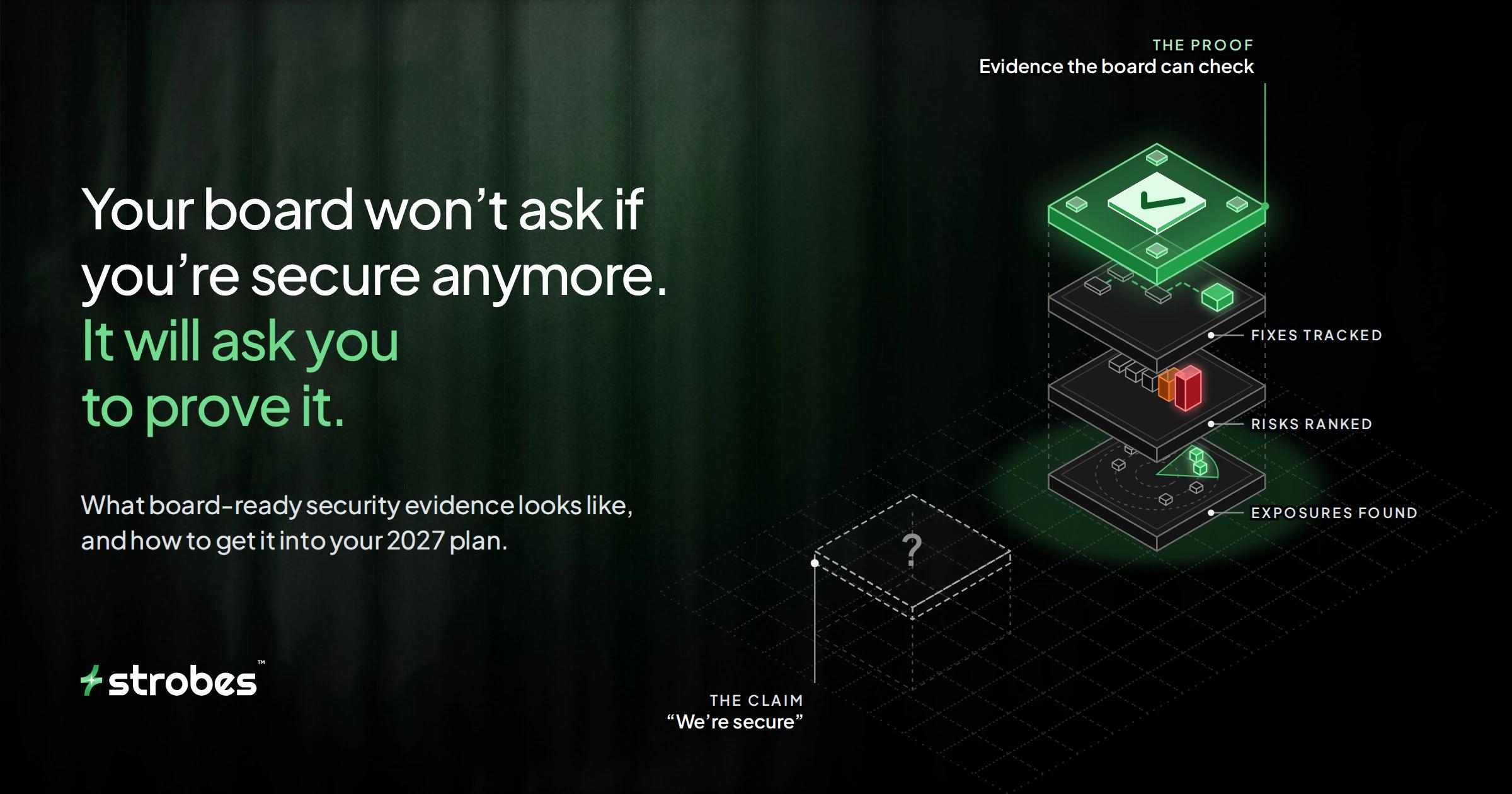
Your board won't ask if you're secure anymore. It will ask you to prove it.
- ✓Boards now want evidence that cyber risk is within appetite. Vulnerability counts, CVSS heat maps, and old pentest reports don't provide it.
- ✓Evidence has three traits: exploitability is demonstrated, validation is current, and every fix is retested.
- ✓Govern autonomous security tools, including AI pentesting agents, like insider risk: defined permissions, enforced scope, audit trails, a kill switch, and human review.
- ✓For 2027 budgets, move pentest spend to continuous testing, fund validation before more discovery, and report validated exposures instead of raw counts.
Every CISO I talk to this quarter is doing two things at once: building a 2027 plan and rebuilding a board deck. The two exercises have collided on one question.
It used to be "Are we secure?" Boards stopped trusting the answer to that one a while ago.
Now they ask: "What evidence shows our risk is actually within appetite?"
Most security programs can't answer that, and it's mostly a tooling problem. Scanners and periodic tests were built to find issues. Proving which ones matter is a different job.
Why doesn't the usual board report answer the question?
In my conversations with CISOs and their boards this year, two questions keep coming up: Where do we draw the line on AI autonomy? What evidence shows our controls actually work? Underneath both is one test of a security leader: can you shape decisions when disruption hits, or only report on it afterward?
You can't influence a decision with a vulnerability count.
Think about what lands in a typical quarterly board update:
- Thousands of open vulnerabilities, trending slightly down
- A heat map colored by CVSS severity
- A clean pentest report from eight months ago
- Patch SLA compliance percentages
None of that is evidence. It's activity. A board member with any risk background will ask the follow-up you dread: "Which of these could actually hurt us, and how do you know?"
Why can't your current stack produce evidence?
I've spent years building offensive security products, and I keep seeing the same three gaps.
Severity scores don't measure exploitability. A critical CVSS score says a flaw is dangerous in theory. It says nothing about whether an attacker can reach it in your environment, chain it, and get to something that matters. Teams burn cycles patching "criticals" that were never reachable while the exploitable medium sits in a forgotten staging environment.
Point-in-time testing expires fast. Your annual pentest was accurate on the day it ended. Since then you've shipped hundreds of releases, changed identity policies, and spun up new cloud accounts. Environments now change faster than periodic tests can validate, which is why leading programs are moving to continuous, change-triggered validation as their primary proof of resilience.
Discovery without validation is noise. Ask security leaders where their programs are weakest and you hear the same two answers: knowing what's actually exposed, and responding fast when it matters. Teams can't respond well to what they can't see, and they can't prioritize what they haven't validated.
Most teams also underestimate how much of their backlog is noise. In independent testing on the OWASP Benchmark, more than 60% of static analysis findings could be removed as false positives without losing a single real vulnerability. A count-based report can't tell those findings apart from the real ones.
What does evidence actually look like?
If your board wants proof, give them proof. In practice, evidence meets three tests.
- Exploitability is demonstrated. Someone, or something, showed the attack path works: entry point, chain, impact on a named business asset.
- It's current. Validation runs every time your environment changes, so it never waits for pentest season.
- It closes the loop. Every validated exposure has an owner, a fix, and a retest confirming the fix worked.
Meet those three tests and your board slide changes. Instead of "4,200 open vulnerabilities," it reads: "We validated 11 exploitable paths to crown-jewel systems this quarter. Nine are fixed and retested. Two have compensating controls and a date." That's a risk conversation a board can act on.

How should CISOs govern autonomous security tools?
Getting that evidence continuously means letting autonomous agents attack your environment. That's the AI autonomy question your board is already asking.
Here's where I'll say something most vendors in my category won't.
The security leaders I respect most treat autonomous, multi-agent AI as an insider risk. Govern it by what it's allowed to do. Constrain the blast radius. Define explicitly where a human must stay in the loop.
That standard is right, and CISOs should apply it to every autonomous security tool they evaluate, including ours.
An agentic pentesting platform is, by design, a system that attacks your environment. If a vendor can't show you precisely what it's permitted to do, you shouldn't let it near production. Before you approve any autonomous testing platform, ask five questions:
- What actions can the agent take, and which require human approval?
- How is scope enforced, and what happens if it drifts?
- Is every action logged in an audit trail your team can review?
- Can you stop it instantly?
- Do human experts review critical findings before they reach your board?
If the answers are vague, walk away. Autonomy without governance isn't innovation. It's a new insider risk you paid for.
Where should the 2027 security budget go?
The budgets I'm seeing are shifting away from static vulnerability patching and toward continuous exposure validation. The reason is simple: AI is shrinking the time attackers need to go from a new weakness to a working exploit.
Translated into a budget line, here's what I'd do as a CISO this planning cycle:
- Move pentest spend from point-in-time to continuous. Same intent, far more coverage, and evidence that stays current.
- Fund validation before more discovery. Most teams already have more findings than they can fix. The constraint is knowing which ones matter.
- Change the metric. Stop reporting vulnerability counts up the chain. Report validated exposures to critical assets, exposure-window length, and time from fix to retest.
Budgets lock this quarter. "We'll evaluate next year" means another year of reporting activity instead of evidence.
How does Strobes produce this evidence?
We built Strobes on one conviction: security teams need proof more than they need more findings.
Strobes' agentic pentesting runs pentests continuously and confirms which critical vulnerabilities an attacker can actually reach. Nothing counts as a finding until an agent exploits it, and every finding ships with a proof of concept. That keeps our false-positive rate under 5%. Autonomy does the heavy lifting. Human experts stay in the loop where judgment matters.
Strobes Exposure Validation agents take the findings you already have and validate them through exploitation, so your team works on what an attacker can actually use. Every action runs within a defined scope, with approval gates and a full audit trail.
If you want to see what that looks like, one of our pentesters walked through 11 validated Critical and High findings, each with the request that proved it.
What should you do before your next board meeting?
- Rewrite one slide. Replace your vulnerability count with validated exposures to your top five business-critical assets.
- Draw your human-in-the-loop (HITL) line. Document where your team requires human approval for autonomous tools, security tools included, and put it in front of the board before they ask.
Your board has moved past "Are we secure?" The CISOs who win the next two years will be the ones who can answer "Prove it" with data, not adjectives.
Want to see validated exposure data from your own environment? Book a demo.
Frequently asked questions
What should a CISO report to the board instead of vulnerability counts?
Report validated exposures to business-critical assets, how long each exposure stayed open, and the time from fix to retest. Those numbers show real risk and whether remediation worked.
What's the difference between vulnerability severity and exploitability?
Severity, usually a CVSS score, rates how dangerous a flaw is in theory. Exploitability asks whether an attacker can reach that flaw in your environment, chain it with others, and use it against a critical asset. A reachable Medium can matter more than an unreachable Critical.
Why isn't an annual pentest enough evidence for the board?
It's accurate only for the day testing ended. Every release, identity change, and new cloud account after that goes untested until the next cycle. Continuous, change-triggered testing keeps the evidence current.
How do you govern an autonomous AI pentesting tool?
Treat it like an insider with privileged access. Define which actions need human approval, enforce scope, log every action, keep a kill switch, and have human experts review critical findings before they're reported.
What is exposure validation?
Exposure validation uses safe, controlled exploitation to confirm whether a finding can actually be used by an attacker in your environment. It turns a long list of possible issues into a short list of proven ones.