

Is Claude Mythos the End of Pentesting?
TL;DR
On April 7, 2026, Anthropic officially unveiled Claude Mythos Preview - a frontier model that sits in a new tier called Capybara, above Opus. Within weeks of internal testing, Mythos autonomously discovered thousands of zero-day vulnerabilities across every major operating system and web browser, many of which had survived decades of human review.
On April 7, 2026, Anthropic unveiled Claude Mythos Preview — a frontier model in a new Capybara tier above Opus. Within weeks, Mythos autonomously discovered thousands of zero-day vulnerabilities across every major OS and browser, many surviving decades of human review. Cybersecurity stocks tanked. The industry panicked. But does this make every other security tool obsolete? No — and here's why.
This moment forces a critical question: does a model that finds kernel zero-days make every other security tool obsolete? The answer is no — and understanding why requires separating three layers that most people conflate: the model, the harness, and the platform.
The question on everyone's mind: If a model can find zero-days in the Linux kernel, does anything else matter?
The answer is yes - and understanding why requires separating three layers that most people conflate: the model, the harness, and the platform.
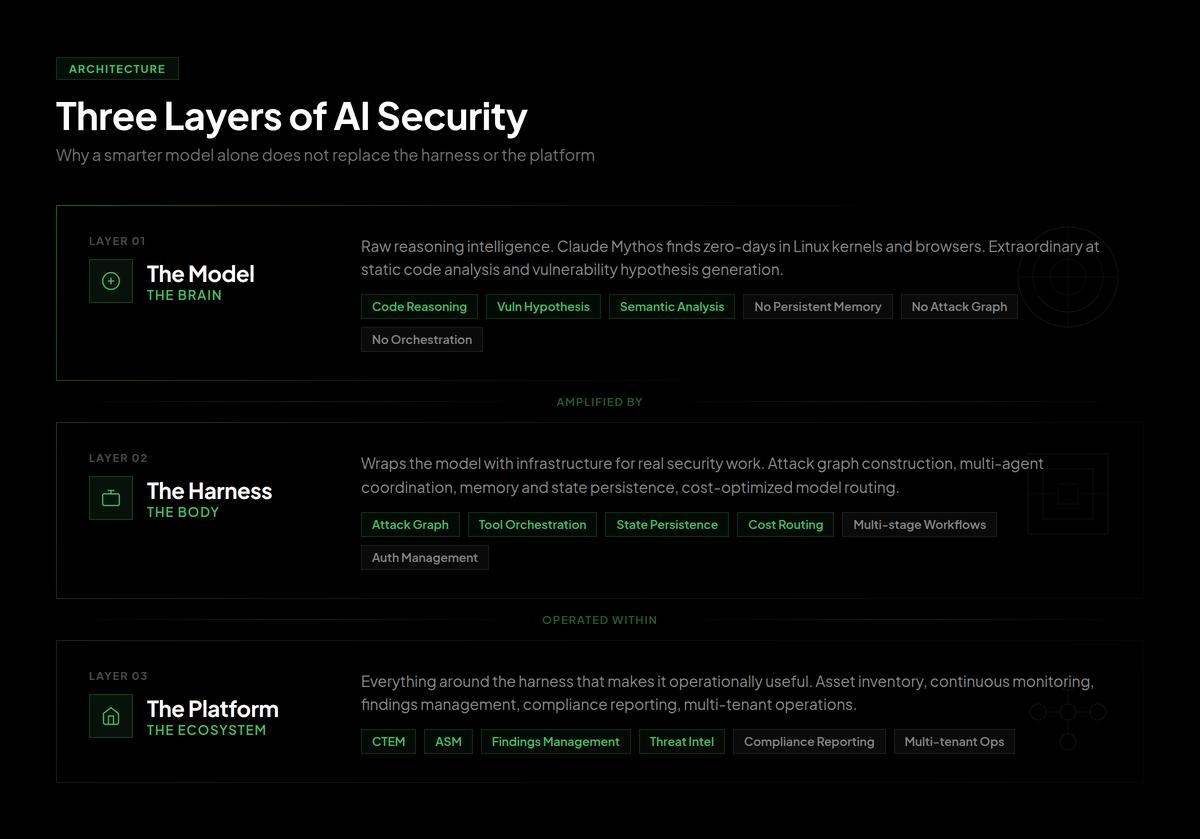
Layer 1: The Model (The Brain)
Since the original Mythos announcement, subsequent updates have only reinforced this layer separation. Frontier models continue to improve at reasoning about code, but they remain dependent on the harness and platform that surround them.
A model is raw intelligence. It can reason, read code, hypothesize about vulnerabilities, and even write proof-of-concept exploits. Mythos is extraordinary at this - arguably a step-change over everything before it.
But a model alone is a brain in a jar. It has:
- No persistent memory. It forgets everything between sessions. It cannot track an engagement over days or weeks.
- No attack graph. It does not maintain a map of discovered assets, relationships between services, or previously attempted attack paths.
- No orchestration. It cannot coordinate multi-stage attacks that chain together reconnaissance, initial access, lateral movement, and privilege escalation across real infrastructure.
- No environmental awareness. It does not know what tools are available, what credentials have been harvested, or what the target's architecture looks like beyond what's in its current context window.
- No cost efficiency at scale. Running a frontier model to fuzz every file in a codebase is extraordinarily expensive. Mythos-class models cost orders of magnitude more per token than purpose-built SaaS tooling for the same coverage.
What Mythos demonstrated - finding bugs in C/C++ core code of Linux, browsers, and Apache - is genuinely remarkable. Fuzzing and auditing low-level system code has always been one of the hardest problems in security. Models are making that tractable for the first time.
But finding a memory corruption bug in a .c file is fundamentally different from executing a penetration test against a live enterprise environment.
Layer 2: The Harness (The Body)
A harness wraps a model with the infrastructure it needs to actually do things. Anthropic's own Mythos testing used a harness: they launched containers, invoked Claude Code, pointed it at source files, let it run experiments, and piped results through a validation agent.
A harness provides:
- Tool access - scanners, fuzzers, exploit frameworks, network utilities
- Memory and state - tracking what's been tried, what worked, what to try next
- Orchestration - sequencing multi-step workflows, parallelizing tasks, managing retries
- Cost control - routing simple tasks to cheaper models, caching results, compacting context
- Authentication and access - managing credentials, API keys, and session state across targets
Think of it this way: Claude Code is a harness. It gives a model a terminal, file system access, and the ability to iterate. But Claude Code is a general-purpose harness. It knows nothing about cybersecurity workflows, attack methodologies, or how to maintain an engagement across multiple targets over multiple days.
A cybersecurity-specific harness needs to understand:
- How to build and traverse an attack surface graph
- How to chain findings from reconnaissance into actionable attack paths
- How to manage multi-profile authentication across different target environments
- How to correlate findings from 20 different tools into a coherent picture
- How to prioritize based on business context, not just CVSS scores
Layer 3: The Platform (The Ecosystem)
A platform is everything around the harness that makes it operationally useful:
- Asset inventory and attack surface management - knowing what to test
- Continuous monitoring - not just point-in-time scans but ongoing exposure tracking
- Credential exposure monitoring - tracking stealer logs, dark web leaks, and breach data
- Threat intelligence integration - understanding which threat actors target your industry and what TTPs they use
- Findings management - deduplication, prioritization, SLA tracking, remediation workflows
- Compliance and reporting - mapping findings to frameworks, generating audit-ready reports
- Multi-tenant operations - serving multiple clients with isolation, access control, and per-client context
No model provides this. No harness provides this. This is what a platform like Strobes provides.
What Mythos Actually Changes (And What It Doesn't)
What changes:
Mythos has proven that models can find vulnerabilities traditional static analysis tools miss entirely. This is not incremental — it's a paradigm shift for code review.
- Static code analysis gets dramatically better. Models like Mythos can reason about code semantics in ways that traditional SAST tools cannot. They find logic bugs, authentication bypasses, and complex vulnerability chains that pattern-matching tools miss entirely.
- Low-level fuzzing becomes accessible. Finding memory corruption in C/C++ code - the kind of bugs that earn $100K+ bounties - was previously the domain of elite researchers with custom fuzzers. Models are democratizing this.
- The bar for "good enough" security tooling rises. SaaS scanners that just run regex patterns against code are going to struggle to justify their existence when a model can do semantic analysis.
What doesn't change:
- Enterprise pentesting is not static analysis. A real engagement involves live systems, network segmentation, authentication flows, business logic, custom APIs, and human-in-the-loop decisions. A model reading source code in a container is a fundamentally different problem.
- Attack surface discovery remains the bottleneck. You can't find bugs in code you don't know exists. Discovering the full attack surface of an enterprise - shadow IT, forgotten subdomains, third-party integrations, cloud misconfigurations - requires continuous automated reconnaissance, not a smarter code reader.
- Cost makes model-only approaches impractical for continuous operations. Running Mythos-class models against every commit, every asset, every day is prohibitively expensive. Intelligent harnesses that route the right tasks to the right models (or to traditional tools when they suffice) are essential.
- Coordination and context cannot live in a context window. A penetration test generates thousands of data points over days or weeks. No model context window - no matter how large - replaces a purpose-built system for maintaining engagement state, tracking remediation, and correlating findings across time.
Where Strobes Fits
Strobes AI is not a model. Strobes AI is not competing with Mythos.
Strobes AI is a Continuous Threat Exposure Management (CTEM) platform with an AI-agent-native harness layer. Here's what that means in practice:
Attack Surface as the Foundation. Strobes' thesis is that the breadth and accuracy of attack surface discovery is the single most important differentiator in automated security. The best model in the world is useless if it's pointed at the wrong targets. Strobes' ASM continuously maps external and internal attack surfaces, including assets that organizations don't even know they have.
Harness-Level Intelligence. Strobes builds the orchestration layer that models need to perform real security work - not just code review in a container, but coordinated multi-tool, multi-stage assessments against live infrastructure. This includes:
- Attack graph construction and traversal
- Dynamic tool selection based on target characteristics
- Multi-agent coordination with memory and state persistence
- Cost-optimized model routing (frontier models for hard reasoning, smaller models for routine tasks)
- Auth broker patterns for managing credentials across targets
Model Agnosticism. Strobes integrates with the best available models - today that includes Claude Opus 4.6 via AWS Bedrock, with the architecture ready to incorporate Mythos-class capabilities as they become available. When models get smarter, Strobes gets smarter. The harness and platform amplify whatever brain you plug in.
The Pentest-to-Patch Data Flywheel. Every engagement Strobes runs generates structured data about real-world vulnerabilities, attack paths, and remediation outcomes. This data compounds over time, creating a proprietary advantage that no model - however intelligent - can replicate from first principles. This is the moat.
Operational Reality. Enterprises don't buy models. They buy outcomes: fewer vulnerabilities, faster remediation, audit-ready reports, and continuous visibility into their exposure. Strobes delivers this as a platform, with AI as the engine - not the product.
Traditional Tools vs. AI-Native Pentesting: A Category Shift
There's a subtler distinction that gets lost in the Mythos hype, and it matters more than most people realize: the difference between a tool and an autonomous reasoning system.
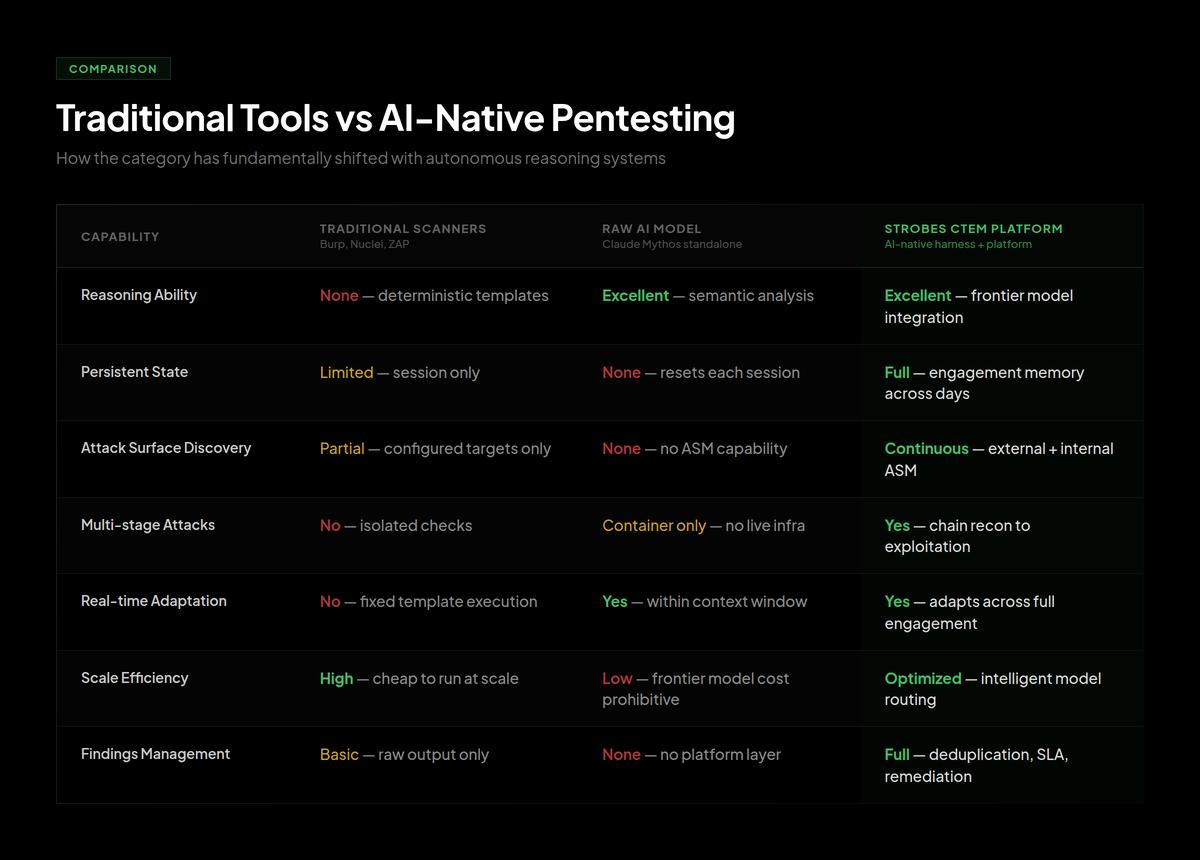
How Traditional Tools Work
Take Burp Suite, Nuclei, or any established security scanner. These tools are fundamentally deterministic. You configure a target, select your test cases or templates, hit run, and the tool executes a predefined sequence of checks. Nuclei runs YAML templates against endpoints. Burp's scanner crawls and fires payloads from a known library. OWASP ZAP follows the same pattern.
The workflow is linear: configure, execute, report. The tool doesn't think. It doesn't adapt mid-scan based on what it's finding. It doesn't reason about whether a 403 response on one endpoint implies a misconfigured access control pattern that might be exploitable on a different endpoint. It doesn't decide to pivot from web application testing to API enumeration because it noticed an undocumented GraphQL endpoint in a JavaScript bundle.
These tools are powerful - they've been the backbone of application security for over a decade. But they are fundamentally execution engines, not reasoning engines.
How Mythos (and Models Like It) Work
Mythos represents the other extreme. It's pure reasoning with a minimal execution scaffold. Anthropic's own testing setup was remarkably simple: launch a container with source code, point Claude Code at it, and say "find vulnerabilities." The model reads code, forms hypotheses, writes test cases, runs them, observes results, adjusts its approach, and iterates - all autonomously.
This is genuinely impressive. But it's also bounded in important ways:
- It operates on source code in a container, not on live production environments with real network topologies, authentication systems, and business logic.
- It has no persistent state between sessions. Every engagement starts from zero.
- It has no operational context - it doesn't know that the target company just acquired another firm and inherited their infrastructure, or that a specific API serves regulated financial data and has different risk implications.
- It is extraordinarily expensive to run continuously. Using a frontier model to reason through every file in a codebase, for every client, on every commit, is not economically viable at enterprise scale.
Mythos is a tool - an incredibly intelligent one - but it's still a tool. A better hammer doesn't become a construction company.
What AI-Native Pentesting Actually Means
AI-native pentesting is neither of these things. It's not a traditional scanner with a chatbot bolted on, and it's not a raw model pointed at code in a sandbox. It's a fundamentally different product category: an autonomous decision-making system for security testing.
Here's what that looks like in practice:
Reasoning about what to test, not just how to test it. A traditional scanner tests everything in its template library against every endpoint it can find. An AI-native system reasons about the target's architecture, technology stack, and business context to decide what matters. It prioritizes testing the OAuth implementation over the static marketing pages - not because a human configured it to, but because it understands the relative risk.
Adapting in real-time based on findings. When an AI-native system discovers a misconfigured CORS policy on one subdomain, it doesn't just log it and move on. It reasons: "If CORS is misconfigured here, the same team likely deployed other services with similar patterns. Let me expand my testing to related subdomains and check for the same class of issue." This kind of lateral reasoning is impossible with template-based tools and impractical with raw models that lack the orchestration to act on it.
Chaining tools, techniques, and findings into attack paths. Traditional tools generate isolated findings: "SQLi on /api/users," "exposed .git directory," "default credentials on admin panel." An AI-native system chains these: "The exposed .git directory reveals the database schema. The SQLi on /api/users can be used to extract credentials. Those credentials may grant access to the admin panel." This is what human pentesters do - and it's what requires a harness with memory, state, and an attack graph.
Operating continuously, not episodically. A Burp Suite scan is a point-in-time event. An AI-native system runs continuously against the full attack surface, incorporating new assets as they appear, re-testing after deployments, and correlating findings over time. This requires a platform layer that no model or traditional tool provides.
The Competitive Landscape After Mythos
This framework clarifies who is actually threatened by Mythos-class models and who isn't:
Threatened: Traditional SaaS scanners. Tools that run static pattern-matching - SAST tools that grep for eval(), DAST tools that fire the same XSS payloads at every input field, dependency scanners that just check version numbers - are increasingly redundant. A model that can reason about code semantics will outperform them on accuracy, and the cost of model inference will continue to fall. These tools were already commoditized; Mythos accelerates their obsolescence.
Not threatened: Intelligent harnesses and platforms. Systems that provide the orchestration, memory, attack surface context, and operational infrastructure that models need to function in real-world engagements become more valuable as models improve. A better brain makes the body more capable, not less necessary.
The new differentiator: Evaluation and benchmarking. As models become interchangeable commodities, the ability to evaluate which model performs best for which security task becomes critical. This is why benchmarking infrastructure - like Strobes' pentest-bench - matters. Not all models reason equally well about authentication bypasses versus memory corruption versus business logic flaws. The harness that can dynamically select the right model for the right task, and prove that selection with data, has a structural advantage.
Frequently Asked Questions
Will Mythos replace human pentesters?
No. Mythos is a powerful code-analysis tool, but enterprise pentesting requires live-system interaction, business logic testing, authentication flows, and human judgment. Mythos automates the tedious parts, making pentesters more productive — not obsolete.
How does Strobes AI use models like Mythos?
Strobes AI is model-agnostic. When Mythos-class models become available through our integrations (including AWS Bedrock), we route the hardest reasoning tasks to them while using smaller, cheaper models for routine checks. Our harness and platform amplify whatever brain you plug in.
Is Strobes AI just another scanner?
No. Strobes AI is an autonomous decision-making system that reasons about what to test, adapts in real time, chains findings into attack paths, and operates continuously. It's a platform, not a template-based tool.
How does the cost of running frontier models compare to traditional penetration testing?
Running a Mythos-class model to fuzz every file in a codebase costs orders of magnitude more per token than purpose-built SaaS tooling for the same coverage. That's why intelligent harnesses — like the one Strobes AI builds — route the hardest reasoning tasks to frontier models and use cheaper models or traditional tools for routine checks. Cost efficiency at scale is a platform capability, not a model capability.
What is the difference between Mythos and traditional pentesting?
Mythos is a code-analysis model that finds bugs in source code. Traditional pentesting involves live systems, authentication flows, business logic, and network topology. Strobes AI bridges the gap by using models like Mythos within a harness that orchestrates real-world engagements, combining code analysis with live testing.
The Bottom Line
Claude Mythos is a genuine breakthrough. It proves that AI can find vulnerabilities that decades of human effort missed. Every security company - Strobes included - should be excited about integrating these capabilities. The question isn't whether models will get smarter; it's whether your organization has the harness and platform to put that intelligence to work.
But the panic is misplaced. A smarter brain doesn't eliminate the need for a body, a nervous system, and an environment to operate in.
Models find bugs. Harnesses execute engagements. Platforms run programs.
Strobes builds the harness and the platform. When the next Mythos drops - and the one after that - Strobes becomes more powerful, not obsolete.
The companies that should worry are the ones selling dumb pattern-matching wrapped in a dashboard. The companies that will thrive are the ones with the orchestration, data, and operational infrastructure to put increasingly powerful models to work.
That's Strobes.
Want to see how Strobes AI combines AI models with a purpose-built harness for real-world engagements? Read more about agentic pentesting with Strobes AI, our AI harness architecture for offensive security, and how agentic pentesting delivers continuous exposure validation.