
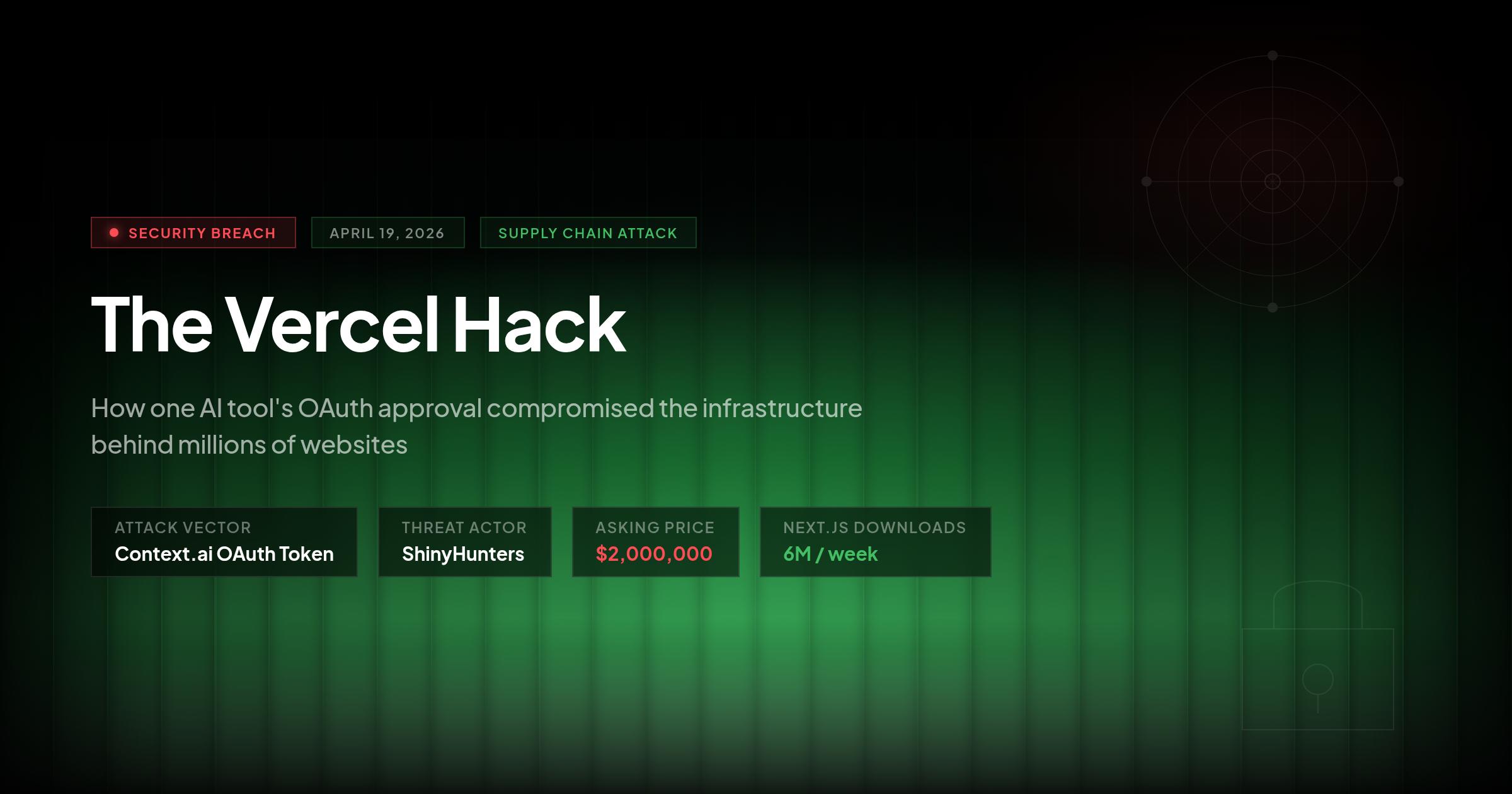
The Vercel Hack: How One AI Tool Compromised the Infrastructure Behind Millions of Websites
TL;DR
Not through a zero-day, not through a sophisticated exploit against their core infrastructure, but through a third-party AI tool one employee had connected to their Google Workspace account. That is what makes this Vercel security breach worth paying close attention to, because that exact integration pattern exists inside almost every engineering organization operating today.
Vercel got hacked. Not through a zero-day, not through a sophisticated exploit against their core infrastructure, but through a third-party AI tool one employee had connected to their Google Workspace account. That is what makes this Vercel security breach worth paying close attention to, because that exact integration pattern exists inside almost every engineering organization operating today.
On April 19, a threat actor posted on BreachForums claiming to have broken into Vercel's internal systems and was selling everything for two million dollars, including access keys, source code, NPM tokens, GitHub tokens, and employee records. Vercel confirmed it the same day. What nobody is saying loudly enough is that this breach was not discovered by Vercel's security team. It was discovered because the attacker chose to monetize publicly. That gap between when access was gained and when anyone knew about it is the most important detail in this entire incident.
The attacker walked in through Context.ai, a legitimate AI productivity tool, to which one Vercel employee had connected their Google Workspace account via OAuth. That single Google Workspace OAuth attack was enough. The connection got compromised, the attacker used the inherited session trust to climb into Vercel's internal environments, and once inside, they started reading environment variables that had never been flagged as sensitive, sitting there unencrypted because someone assumed the platform boundary was the security boundary.
Why This Is a Systemic Risk and Not Just a Vercel Problem
Vercel is the primary steward of Next.js, the React framework with six million weekly downloads, and the deployment platform underpinning thousands of enterprise, startup, and Web3 applications simultaneously. When you compromise Vercel's internal systems, you are not looking at one company's data. You are sitting inside the deployment pipeline of thousands of applications at once, with potential write access to build artifacts, environment variables, and the NPM token infrastructure that feeds packages to every developer running npm install next anywhere in the world.
That is the actual scope of this developer supply chain attack, and it is precisely why the security community reacted the way it did.
How the Attack Unfolded
The Vercel security breach did not start at Vercel. It started at Context.ai, a third-party AI tool used internally by a Vercel employee. Context.ai had been granted access to that employee's Google Workspace account via an OAuth connection, which is standard practice in any modern engineering org. You click approve, the tool gets the permissions it needs, and everyone moves on. It is the kind of integration that happens dozens of times a week across most organizations and rarely gets a second look from security, which is precisely what made it a viable attack vector.
Context.ai itself got compromised. The attacker exploited that breach to hijack the OAuth token and take over the Vercel employee's Google Workspace account entirely. From there, the escalation was methodical and fast. They pivoted from the Workspace account to Vercel's internal environments using the inherited trust of that OAuth session and, once inside, began enumerating environment variables across internal systems. This is a textbook OAuth token abuse scenario that most threat models underestimate because the initial compromise happens upstream at a vendor rather than at the target organization directly.
The environment variable architecture became the secondary escalation path, and the details of that failure are worth their own section below. Vercel CEO Guillermo Rauch later confirmed the attacker demonstrated surprising velocity and a detailed understanding of Vercel's internal systems, describing them as highly sophisticated and likely significantly accelerated by AI. The speed of execution across both stages points to deliberate pre-attack reconnaissance rather than an opportunistic compromise.
ShinyHunters and What They Claim to Have
If the name ShinyHunters sounds familiar, it should. This is the same group, or at least someone claiming affiliation, linked to some of the most consequential data breaches of the last several years, including Ticketmaster, Santander Bank, Rockstar Games, and AT&T. ShinyHunters operates as an organized extortion group with a documented history of large-scale exfiltration followed by monetization through dark web sales or direct ransom demands.

The BreachForums post tied to this Vercel data breach was characteristically brazen. Two million dollars, negotiable down to five hundred thousand in Bitcoin. What they claimed to have included multiple employee accounts with access to internal deployments, API keys, NPM tokens, GitHub tokens, source code, and database data. As proof, they published a text file containing 580 Vercel employee records alongside a screenshot of what appeared to be an internal Vercel Enterprise dashboard.
Attribution remains murky. Threat actors directly linked to the ShinyHunters extortion gang have denied involvement to BleepingComputer. The post could be a splinter actor using the name for credibility, a copycat, or evidence of fragmentation within the group. Security analysts should treat attribution claims in BreachForums posts with appropriate skepticism.
What is not in dispute is the NPM token claim. The attacker's own language on the forum thread was explicit. Send one update with a payload, and it will hit every developer on the planet who runs an installation or updates a package. That framing is not accidental. It is a deliberate attempt to position this as a Next.js supply chain risk to maximize the perceived value of what they are selling. Vercel has since confirmed that Next.js, Turbopack, and their open source projects have been audited and remain safe, but the threat vector was credible enough to require a formal supply chain audit, which tells you something about what was actually at stake.
The Environment Variable Design Flaw That Made Escalation Easy
The attacker did not just exploit a technical vulnerability. They exploited a design assumption, which is a meaningfully different and more dangerous category of problem.
Vercel's environment variable system operates on an opt-in security model. Mark a variable as sensitive, and Vercel encrypts it at rest in a way where even Vercel's own internal systems cannot read the value back. That is a strong security guarantee. The problem is that the sensitive designation is optional rather than the default. Variables without that flag are stored in a readable state internally, operating on the implicit trust model that any actor with internal system access is authorized to read configuration data, and that trust model is exactly what the Google Workspace OAuth attack dismantled.
Once inside Vercel's internal environments, the attacker did not need to break any cryptographic controls. They enumerated what was already readable. Database connection strings, third-party service credentials, internal API keys, and authentication tokens all end up in environment variables because that is the intended use case for them. The security expectation has always been that the platform boundary is the control, but Vercel built a system where that expectation is technically incorrect for any variable not explicitly flagged as sensitive. Rauch confirmed directly that the non-sensitive variable designation was the mechanism through which the attacker achieved further access post-compromise. Vercel has since shipped improved tooling for sensitive variable management, but the lesson for every security architect reviewing similar systems is straightforward. Security-relevant defaults should be secure by default, not secure by intention.
The Attacker Was Using AI, and That Changes the Threat Model
Rauch's post-breach statement contained a detail that most coverage treated as a footnote. He described the attacker as highly sophisticated and strongly suspected them of being significantly accelerated by AI, specifically noting their surprising velocity and in-depth understanding of Vercel's internal systems. That detail changes how security teams should be thinking about their incident response timelines.
An AI-accelerated attacker is not simply an attacker with better tooling. It is an attacker who has compressed every phase of the kill chain. Reconnaissance that previously required days of manual enumeration can be automated and parallelized. Lateral movement decisions that required human judgment can be driven by models trained to recognize environment patterns and predict high-value pivot paths. The operational velocity Rauch described, from the Context.ai compromise through OAuth token abuse into Vercel internal environments and through environment variable enumeration, is consistent with AI-assisted decision-making at each stage.
Traditional incident response playbooks are calibrated for threat actors who move at human speed. An AI-accelerated attacker operating at machine speed finds the gaps before defenders close them. By the time an anomaly surfaces in your SIEM, the exfiltration may already be complete.
The Vercel security breach in April 2026 is evidence that this is operational now, not theoretical. For detection engineering and incident response teams, the implications are concrete. Dwell time assumptions built around human attacker pace need to be revisited, alert thresholds calibrated for slow lateral movement will miss fast AI-driven campaigns, and the third-party AI tool supply chain attack vector that enabled initial access here is specifically designed to operate below the visibility threshold of most organizations because the traffic it generates looks indistinguishable from normal authorized tool behavior. This pattern is not isolated to this incident alone -- we saw the same class of AI-assisted escalation documented in the LiteLLM PyPI supply chain compromise earlier this year.
What Vercel Is Doing and What You Need to Do Right Now
Vercel engaged Google Mandiant within hours alongside additional cybersecurity firms, industry peers, and law enforcement. They published an indicator of compromise immediately, releasing the Google Workspace OAuth client ID tied to the attack so other organizations could check for exposure. The IOC is an OAuth app ID 110671459871-30f1spbu0hptbs60cb4vsmv79i7bbvqj.apps.googleusercontent.com. If that app appears in your Google Workspace OAuth audit, treat it as a confirmed compromise indicator and escalate accordingly.
Rauch confirmed on X that Next.js, Turbopack, and all open-source projects have been audited and remain safe. Vercel has shipped dashboard updates with an improved sensitive variable management interface and is directly notifying customers where specific concerns exist. The full scope of exfiltration and the legitimacy of the ShinyHunters source code and NPM token claims has not been formally confirmed or denied, and the investigation with Mandiant and law enforcement remains ongoing.
If your organization has infrastructure deployed on Vercel, here is your immediate response checklist.
Pull a full OAuth app audit on your Google Workspace now. Go to Admin Console, Security, API controls, App access control. Review every third-party app that has been granted access, focusing on anything with sensitive scopes, including Gmail.readonly, drive, calendar, and admin.directory. Check for the IOC listed above. If you cannot articulate a current business justification for a specific app's permission scope, revoke it. This action matters for every organization, not just Vercel customers, because the same class of risk that enabled initial access in this Vercel security breach exists anywhere SaaS and AI tool integrations have been approved without periodic review.
Inventory every AI tool connected to internal systems via OAuth. Context.ai was a legitimate, professionally used platform. The threat model for third-party AI tool supply chain attacks is not about obviously suspicious integrations. It is about trusted tools sitting inside your OAuth graph, inheriting that trust implicitly. Build a registry of every AI tool integration across your organization, the scopes they hold, and the last time those grants were reviewed.
Rotate every credential stored in the Vercel environment variables. API keys, database connection strings, third-party service tokens, authentication secrets, and webhook signing keys should all be rotated immediately. Treat any variable not explicitly marked sensitive as confirmed-read by an unauthorized actor. The cost of rotation is measured in hours. The cost of a compromised credential in production is not.
Reclassify all environment variables in your Vercel dashboard. Anything containing a credential, token, or connection string should be marked sensitive immediately. The updated Vercel interface makes this audit straightforward. Do not wait for a scheduled security review cycle.
Move toward short-lived credentials and runtime secret retrieval. GitHub OIDC federation to AWS, GCP, or Azure eliminates long-lived static keys from your deployment configuration. Cloud-native secret managers like AWS Secrets Manager, GCP Secret Manager, or HashiCorp Vault accessed at runtime significantly reduce the attack surface inside any deployment platform.
Review recent build logs for cached credentials. If any secrets were present in build output, log streams, or error traces during the compromise window, they may be persisted in places your initial rotation sweep will miss.
For teams who want a structured way to assess how exposed your environment is to this class of attack, the Strobes AI supply chain incident response workflow covers exactly this scenario.
What This Attack Class Means Going Forward
The Vercel hack will be remembered as the breach that made AI tool OAuth hygiene a board-level conversation. It should also be remembered for something the post-incident coverage has mostly glossed over. There is no anomaly to detect when your initial access vector is a trusted third-party integration operating entirely within normal OAuth permission flows. The attacker was not caught by Vercel's security tooling. They were caught because they chose to post about it publicly. That is the visibility gap this entire incident lived inside.
The harder problem for security architects is that this attack class scales. The same OAuth compromise pattern run against a tool with broader organizational adoption hits every company that approved it. The IOC Vercel published points to a Google Workspace OAuth app that potentially affected hundreds of organizations across many companies. Most of them will never know they were in scope.
The more consequential data point for security leaders is not the IPO timing or the competitive fallout. It is that a company with the engineering sophistication of Vercel, running a security-conscious operation at scale, was compromised through a tool integration that would pass any standard vendor review. That should recalibrate how every organization thinks about risk in its own OAuth graph. The tooling layer is the new perimeter, and right now it is under-inventoried, under-monitored, and largely ungoverned. The Vercel data breach is not the first incident in this class. It is simply the most visible one so far. If you want broader context on how this attack pattern fits into the current threat landscape, the worst data breaches of March 2026 and the 2026 cybersecurity trends breakdown both document the accelerating cadence of supply chain and OAuth-based intrusions.
Right now, somewhere in your organization, an AI tool has OAuth access to an internal system that has never appeared on a security review. You approved it in thirty seconds six months ago and have not thought about it since.
That is the exact gap this attack lived in. Strobes maps it continuously, and AI agents triage and validate what they find before an attacker does. If you want to know what is sitting unmonitored in your environment today, start with a demo.